Conflict Watchlist 2022
Report
10 Conflicts to Worry About in 2022: Haiti | Mid-Year Update
Haiti faces intensified gang violence amid ongoing political instability, leading to civilian insecurity.


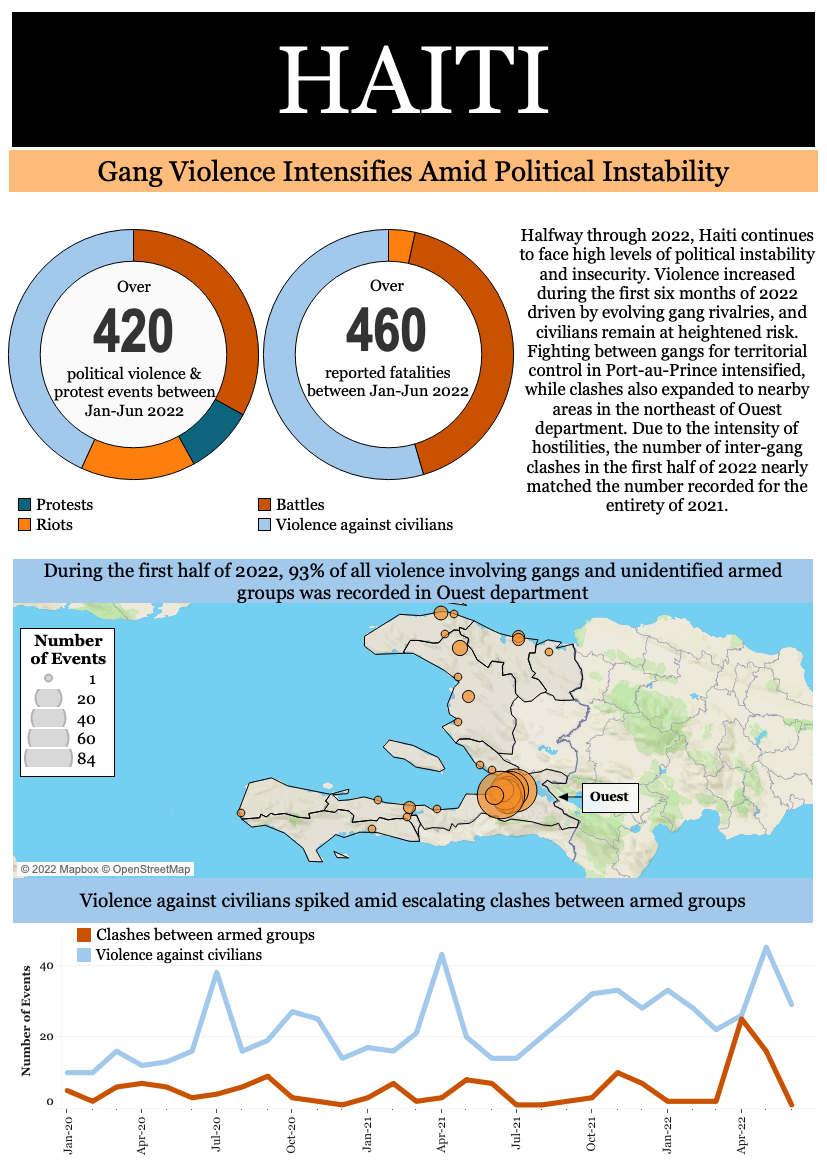
Gang Violence Intensifies Amid Political Instability
Halfway through 2022, Haiti continues to face high levels of insecurity and political instability. Following the assassination of President Jovenel Moise in 2021, the transitional government is still yet to set dates for general elections and controversial constitutional reforms (Alterpresse, 28 March 2022; Le Nouvelliste, 1 July 2022). In the time since, violence has intensified and spread, with the emergence of new conflicts between gangs and ongoing attacks on civilians.
The upward trend of violence in the last months of 2021 continued into the first half of 2022, driven by worsening gang rivalries. Fighting between gangs over control of strategic neighborhoods in Port-au-Prince intensified, while the violence also expanded to nearby areas in the northeast of Ouest department. Areas of expanding conflict include the commune of Tabarre, controlled by the Chien Méchan gang, and Croix-des-Bouquets, a stronghold of the 400 Mawozo gang (Alterpress, 10 February 2022). At the start of 2022, ACLED identified the strengthening of 400 Mawozo and their territorial expansion as a factor that could potentially generate new conflicts. In the first six months of 2022, the number of violent events involving 400 Mawozo almost doubled compared to the year prior. Most notably, 400 Mawozo’s advance towards territories in the adjacent Tabarre commune led to clashes with the rival Chien Méchan gang, a member of the G-9 alliance, between 24 April and 6 May (RNDDH, 10 May 2022). Owing to the increased intensity of hostilities, ACLED records almost the same number of inter-gang clashes in Haiti during the first half of 2022 as in the entirety of 2021. In Croix-des-Bouquets district and Tabarre, violence involving these gangs resulted in at least 190 reported fatalities between 24 April and 6 May, making northeastern Ouest department a new hotspot for Haiti’s gang conflict. More violent events were reported in Croix-des-Bouquet and Tabarre in the first half of 2022 than in any whole year since ACLED started coverage of Haiti in 2018.
Similarly, gang activity increased in the commune of Petionville in the southeastern part of Port-au-Prince district, with nearly double the number of violent events so far in 2022 compared to the entirety of 2021. The spike in violence comes as gangs increasingly contest control of Petionville, a wealthy area home to many of the country’s political and social elites. Here, gang violence predominantly consists of abductions, which are part of a strategy to secure income from ransoms (Insight Crime, 11 April 2022). Attacks have also proliferated as gangs attempt to bolster their authority, attacking and burning the houses of civilians accused of collaborating with law enforcement. The Ti Makak gang has resumed activity in the area after police previously dismantled its networks in 2021. Meanwhile, the Vitelhomme gang, an ally of 400 Mawozo, intensified offensives in the Pernier neighborhood and other areas between Tabarre and Petionville (The Haitian Times, 21 June 2022; Haiti Libre, 26 June 2021).
The territorial expansion of the 400 Mawozo and Vitelhomme gangs in the eastern areas of Ouest department may challenge the hegemony of the G-9 alliance. Continually seeking to diversify their sources of income, the gangs have been taking control of routes that connect Ouest department to the border with the Dominican Republic for smuggling activities (France 24, 4 May 2022). Experts further claim that 400 Mawozo has likely joined the G-PEP alliance — a rival of G-9 in the territories of Cité Soleil, Delmas, and Martissant — thus reshuffling the balance of power between the two gang coalitions (Insight Crime, 20 May 2022). The rise of violence in Petionville, Tabarre, and Croix-des-Bouquet seems to indicate the opening of a new front, which may further challenge G-9.
In the center of Port-au-Prince and the communes of Delmas, Cité Soleil, and Carrefour — mainly controlled by members of the G-9 gang alliance — violence has also persisted at heightened levels in 2022. Gangs have continued to exert control over National Road 2 that connects the southern regions with the capital, setting up roadblocks and carrying out frequent mass kidnappings of bus passengers. Abductions and attacks on civilians constitute 64% of gang violence in these areas, as these tactics are used to strengthen gang authority and provide funds to support territorial expansion and warfare with rivals. The threat of an emerging counter-power to G-9 has further driven violence in the area. A series of clashes between G-9 and G-PEP over control of Cité Soleil in mid-July reportedly resulted in the deaths of over 200 gang members and civilians.
In an attempt to deal with the upsurge of violence in Ouest department, the police have continued anti-gang operations. However, the intensity of police operations has varied across locations, potentially indicating that law enforcement has focused on fighting new gang expansions rather than intervening in areas already controlled by the G-9 alliance. While clashes between police and armed groups in the G-9-controlled Port-au-Prince district in the first half of 2022 remained at similar levels to the same period in 2021, ACLED records over four times the number of such clashes in Croix-des-Bouquet. Most clashes between police and gangs during the first six months of the year involved the 400 Mawozo and Vitelhomme gangs. Notably, human rights organizations have accused state forces of providing armored vehicles to the G-9 alliance (RNDDH, 26 June 2022), which allegedly has ties to the ruling political elite (Rezo Nòdwes, 3 September 2021).
Despite the transitional government’s attempts to restore order, civilians across the country have continued to face high risks of violence. The escalation of conflict between the 400 Mawozo and Chien Méchant gangs in Croix-des-Bouquets and Tabarre has left many civilians caught in the crossfire. During the April to May clashes, gangs attacked residents and burned down houses, along with numerous reports of sexual violence (RNDDH, 26 June 2022). Residents accused of supporting rival gangs were targeted for reprisals, while gangs also selected high-profile targets for kidnapping over their purported wealth, including businessmen, health workers, and teachers (UN, 13 June 2022). Journalists, judges, and lawyers also continue to be attacked by criminal groups that seek to halt investigations into their activities. In January, gang members killed two journalists reporting on criminality in Petionville and also attacked local media facilities.
Meanwhile, gangs have also continued to challenge government and state institutions. Attacks on government officials and facilities are common, underscoring the lack of state capacity to mitigate the violence (FJKL, 14 June 2022). In June, the Base 5 Secondes gang took control of a courthouse in Port-au-Prince, burning judicial documents on cases of police corruption and political assassinations (Miami Herald, 16 June 2022). To date, the courthouse remains under the gang’s control.
Amid continuing violence, ACLED records a sharp decline in demonstration activity in the first half of 2022 compared to the same period in 2021. Ongoing insecurity, however, remains a key driver of the demonstrations that continue to be held in the country. Demonstrations peaked in March, with students and teachers barricading roads across Port-au-Prince, while health workers launched a three-day strike. Demonstrators accused the transitional government of inaction and failure to counter the security crisis (24 Heures, 30 March 2022).
Going into the second half of 2022, Haiti appears to be at an impasse. While holding elections remains a key step toward calming the political crisis, the prospect of organizing a vote looks to be increasingly imperiled by an ever-worsening climate of insecurity.