Report
Defection and violence against civilians in Sudan's al-Jazirah state - November 2024
Defection and violence against civilians in Sudan's al-Jazirah state.
18 November 2024
Sudan at a Glance: 5 October – 8 November 2024
VITAL TRENDS
- Since fighting first broke out between the Sudanese Armed Forces (SAF) and paramilitary Rapid Support Forces (RSF) on 15 April 2023, ACLED records 8,752 events of political violence and more than 27,120 reported fatalities in Sudan.
- From 5 October to 8 November 2024, ACLED records 605 political violence events and over 2,270 reported fatalities.
- Most political violence was recorded in Khartoum and al-Jazirah states during the reporting period, with 198 and 151 events and 231 and 1,010 reported fatalities, respectively.
- The most common event type was violence against civilians, with 254 events recorded, followed by explosions/remote violence, with 192 events. Compared to the previous four weeks, ACLED records a 129% increase in violence against civilians events. Most of these events were recorded in al-Jazirah.
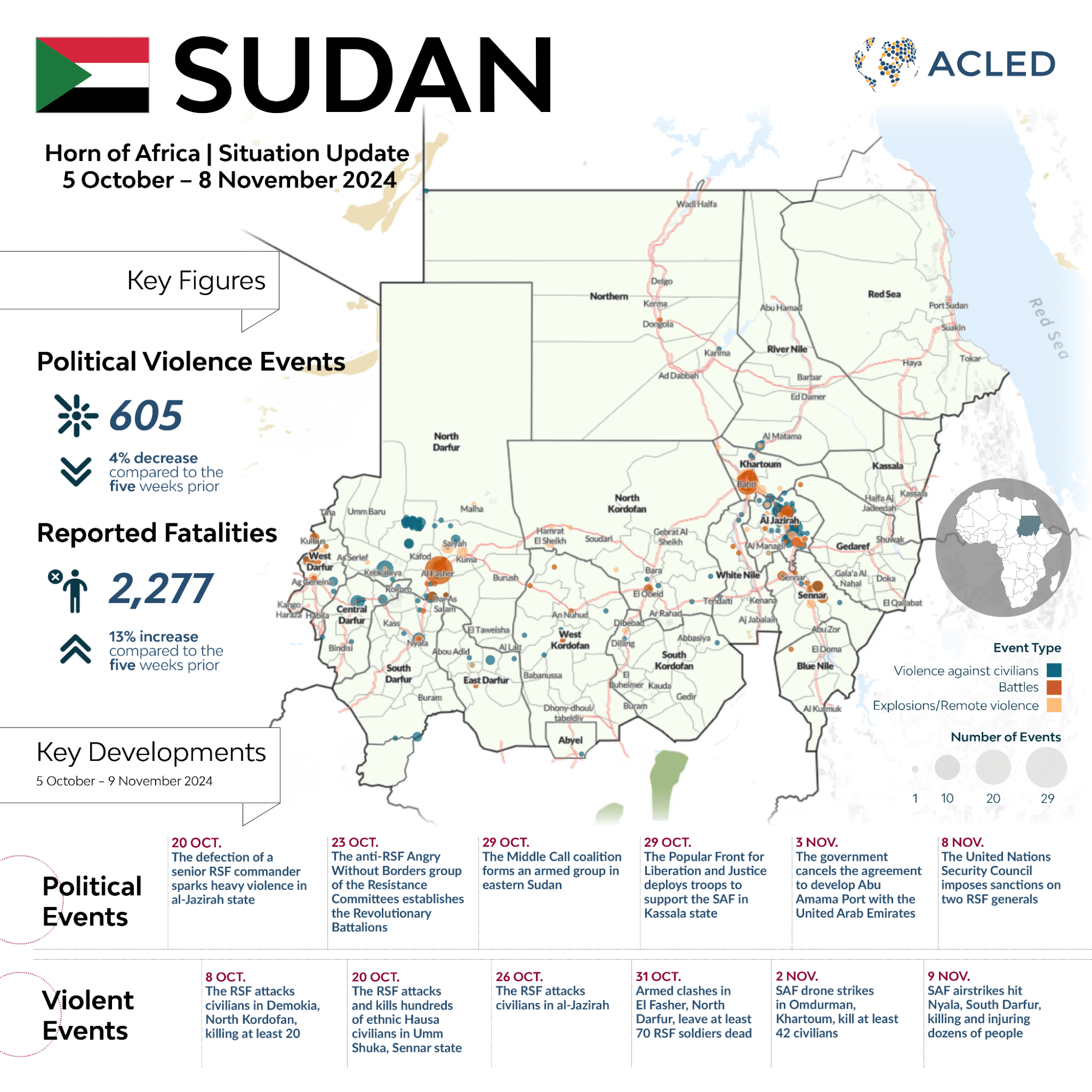
Defection and violence against civilians in al-Jazirah state
The Sudanese army achieved significant breakthroughs in al-Jazirah and Sennar states, where the SAF launched large-scale offensives in October. In al-Jazirah, the defection of a senior RSF commander was followed by a spate of retaliatory violence that targeted his home region. This violence has killed hundreds and sparked widespread condemnation of the RSF’s targeting of unarmed civilians. The SAF also continued to push forward in southern and eastern Sennar state, where it seized control of several RSF positions and forced the paramilitary group to go on the defensive.
Commander's defection sparks violent retaliation against civilians in al-Jazirah
The defection of senior RSF commander Abu Aqla Keikel has sparked a punitive campaign of violence against the population of al-Jazirah, which caused widespread displacement and hundreds of deaths. A former army officer, Keikel defected to the SAF on 20 October. He was among the founders of the Free Butana Forum — a local civil society initiative in the al-Butanah region, spanning Khartoum, al-Jazirah, and Gedaref states. Subsequently, in December 2022, he formed and commanded the Sudan Shield Forces, recruiting fighters from al-Butanah1 before aligning with the RSF in August 2023.2 Keikel led RSF troops during the successful offensive on al-Jazirah in December 2023 and has since served as regional commander for the RSF.3
The SAF allegedly orchestrated Keikel’s defection to weaken the RSF’s hold in eastern al-Jazirah. Days before Keikel and his forces defected to the SAF, the SAF launched coordinated offensives from Sennar and Gedaref states into al-Jazirah, regaining control over several villages before the RSF regrouped around Shabarga, where they repelled SAF troops after fierce clashes (see map below).4 According to some sources, Keikel was granted amnesty following negotiations facilitated by community leaders and SAF officers from al-Butanah.5 Keikel’s defection enabled further SAF advances into Tamboul town in Sharg al-Jazirah locality and surrounding areas, although the RSF counterattacks reportedly killed 370 army soldiers and forced the SAF to withdraw from Tamboul. Among the dead in the clashes was the SAF commander in al-Butanah, Brigadier General Ahmed Shaa al-Din, who is reported to have overseen Keikel’s defection.6
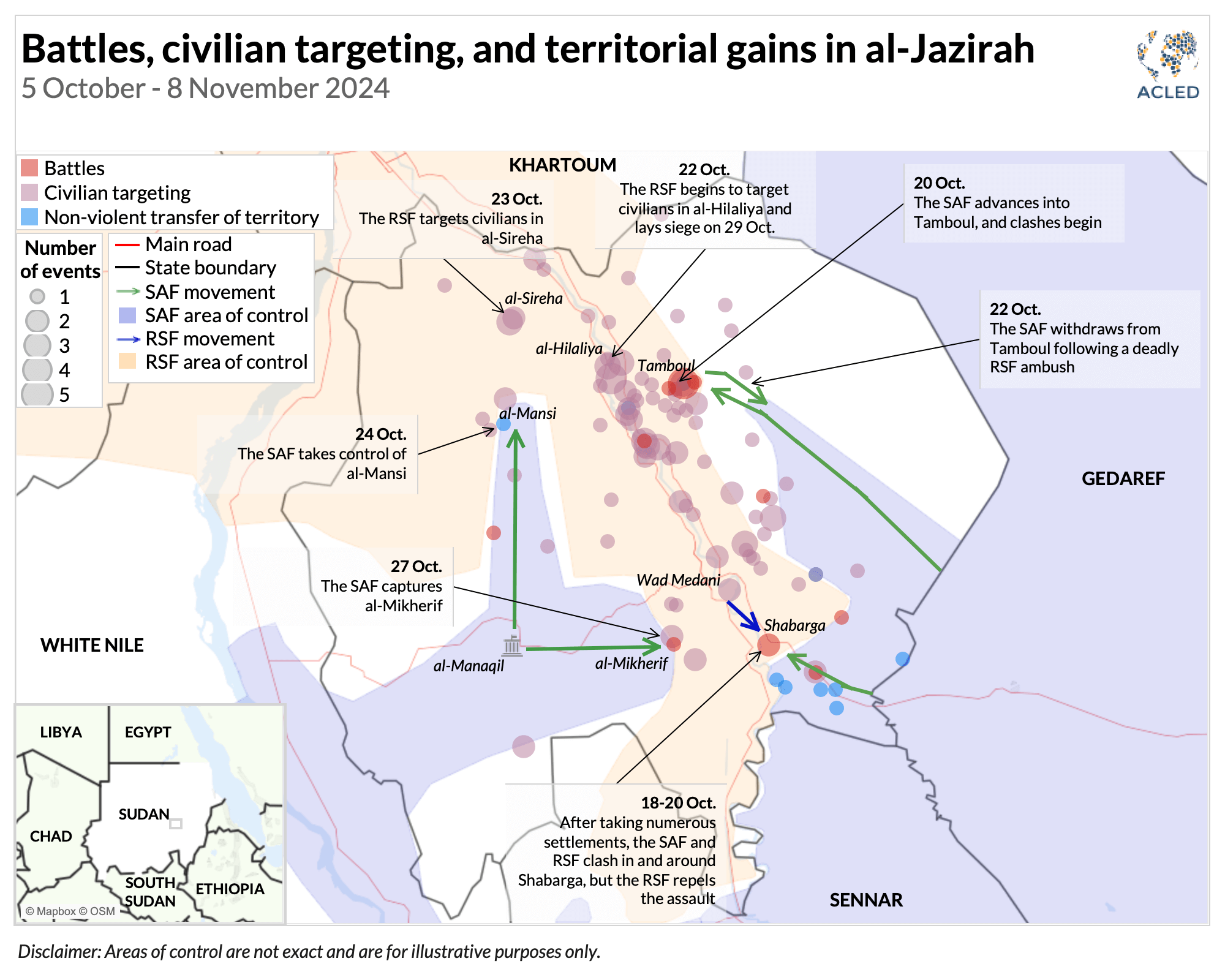
In the aftermath of these events, the RSF unleashed a violent retaliation against civilians in al-Jazirah. The paramilitary group accused the SAF of arming communities to put them in a direct confrontation with the RSF, creating a pretext for the retaliatory campaign.7 Attacks against civilians were reported in at least 70 villages and mainly targeted Keikel’s ethnic group, the Shukriya. At least 316 civilians were reportedly killed between 20 October and 8 November. RSF gunmen reportedly committed several acts of sexual violence, torched and looted villages, and forced an estimated 135,400 people to flee their homes.8
Residents of al-Sireha and al-Hilaliya villages were especially targeted. In al-Sireha, the RSF reportedly killed between 50 and 500 men, injured around 200 others, and abducted 150 civilians during an attack on 25 October. Some victims of sexual violence committed suicide following the assaults.9 The RSF claimed that its attacks were in response to an armed mobilization incited by the SAF.10 In al-Hilaliya village — home to the family of defected commander Keikel — the RSF began its attack on 22 October by looting the village. Then the RSF issued an ultimatum for the local population to hand over Keikel’s relatives.11 Since 29 October, the RSF has imposed a siege on the village and reportedly killed hundreds, looted houses and markets, and raped many women, forcing hundreds to leave their residences and find shelter in three mosques sieged by RSF gunmen.12 At least 500 people might have died in the siege of al-Hilaliya, including dozens from a diarrhea outbreak attributed to the RSF poisoning food supplies.13
The defection of Keikel has had devastating consequences for the Shukriya ethnic group and local communities in eastern al-Jazirah state. An agreement between the RSF and residents of al-Hilaliya, concluded on 18 December 2023,14 had maintained peace in the area, with no recorded incidents of violence before 22 October. However, the RSF suffered major setbacks after Keikel’s defection and, thus, waged a punitive campaign against the civilian population to reassert control over its territory and deter further defections among its ranks.
Despite Keikel’s defection, the RSF’s horizontal structure has enabled it to absorb the impact of recent defections in al-Jazirah as well as in Khartoum and West Kordofan states. The RSF’s structure allows its troops to reorganize based on the need on the ground rather than being dependent on a hierarchical chain of command. This structural adaptability, combined with a tactical approach that focuses on consolidating forces in key areas, has allowed the RSF to regroup strategically and maintain resilience in the face of SAF offensives. By withdrawing from less significant locations, the RSF has concentrated its defense lines in critical positions, such as Shabarga, which has effectively blocked the SAF’s advance toward Wad Madani, the capital of al-Jazirah state. This approach underscores the RSF’s priority to maintain control over strategically valuable locations despite intensified SAF pressure.
The SAF advances in Sennar state
Sennar state was also home to significant developments over the past month, with active conflict lines moving southward and eastward. Heavy clashes broke out on 18 October in the east and south of the state in parallel with the escalation in neighboring al-Jazirah. In these areas, the SAF advanced and captured several villages and towns. When the RSF took control of al-Jazirah in December 2023, the SAF’s 1st Infantry Division withdrew in the direction of Sennar city, which led to clashes in the northern parts of the state. Sennar city also went under siege after the state capital, Sinja, fell to the RSF in July. The siege continued until 5 October, when the SAF successfully linked its forces in Sennar city with those in White Nile state.
Warring parties are especially vying for the control of Jabal Moya, a mountain range overlooking Sennar city from the west. The RSF seized Jabal Moya on 24 June, undermining SAF defensive positions in Sennar. However, the SAF’s successful recapture of Jabal Moya on 5 October gave the army an opportunity to link its troops in Sennar city with those in White Nile state, effectively besieging RSF troops in central areas of Sennar state (see map below).15 The SAF deployed its reinforcements along the state’s eastern borders and advanced on 18 October from Gedaref state on the town of al-Dinder, which it captured after heavy clashes with the RSF in the east of Sennar. Al-Dinder is located at a strategic conjunction on the road linking Sennar and Gedaref states.
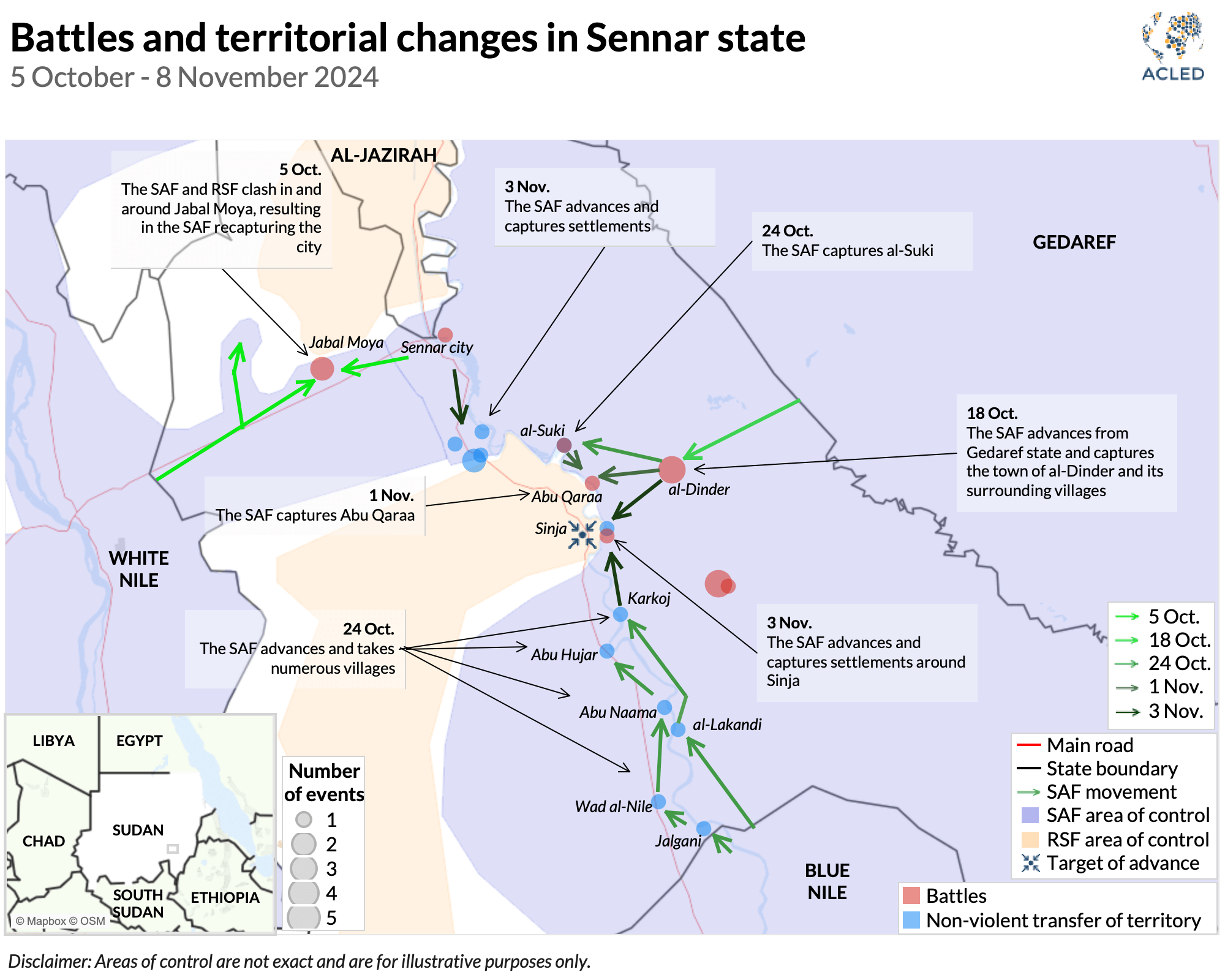
In response to the RSF’s incursion into Blue Nile state in early August 2024, SAF troops previously in Blue Nile state moved north toward Sinja. This pincer movement tightened the siege around RSF positions in central Sennar state, forcing RSF troops to withdraw from Abu Hujar and al-Suki localities. The RSF now faces a difficult situation, risking a decisive defeat as they remain isolated from other RSF troops in neighboring al-Jazirah and White Nile states. Meanwhile, the RSF strategy in al-Jazirah — deploying its forces to key areas to stop the SAF’s advancement — appears unfeasible in the eastern parts of Sennar. This is potentially due to the area’s challenging geography as the Dinder River restricts the RSF troops’ ability to move, the SAF’s overwhelming troop numbers, or shortages in the RSF weaponry and reinforcements. The SAF, advancing from multiple strongholds, is consolidating its hold by linking its forces across Sennar, Gedaref, White Nile, and Blue Nile states. The next likely SAF target will be Sinja city, the capital of Sennar, as its troops advance from Sennar city in the north, al-Suki and al-Dinder in the northeast, and Abu Hujar in the south.
Footnotes
- 1
Sudan Tribune, ‘Central Sudan’s new armed group of Al-Butana region,’ 22 December 2022
- 2
- 3
- 4
Sudan War Monitor, ‘Coordinated offensives in Sennar and Jazira pressure the RSF,’ 23 October 2024
- 5
Sudan Tribune, ‘RSF commander defects to Sudanese army in Al Jazirah state,’ 20 October 2024
- 6
Sudan Tribune, ‘Sudanese army commander killed in RSF ambush in Al Jazirah state,’ 22 October 2024
- 7
Sudans Post, ‘RSF accuses SAF of arming civilians in Al Jazira,’ 29 October 2024
- 8
- 9
Sudan Tribune, ‘47 rapes reported in Sudan’s Al Jazirah; 11-year-old girl dies,’ 2 November 2024
- 10
- 11
Sudan Tribune, ‘UN condemns ‘horrific’ crimes by Sudanese paramilitary force,’ 26 September 2024
- 12
- 13
Reuters, ‘Dozens die of mysterious illness in besieged Sudan town,’ 7 November 2024
- 14
- 15
Sudan War Monitor, ‘Coordinated offensives in Sennar and Jazira pressure the RSF,’ 23 October 2024