
Update
Somalia: Al-Shabaab's Infiltration of a Military Base in Mogadishu and Somaliland's Conflict - February 2024
Somalia faces continued violence and political instability amid Al-Shabaab attacks and Somaliland conflicts.
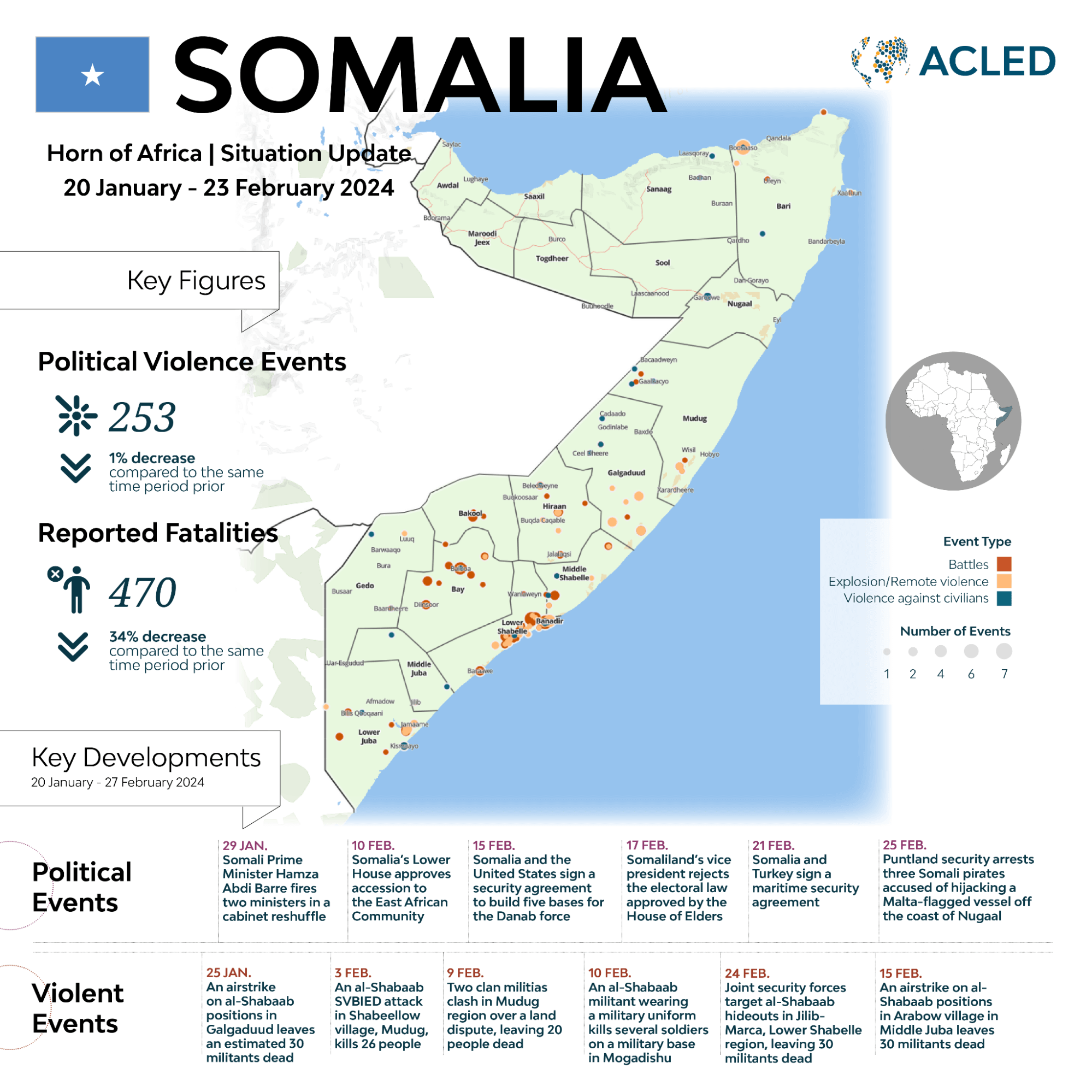
Somalia at a Glance: 20 January to 23 February 2024
- ACLED records more than 250 political violence events and at least 470 reported fatalities from 20 January to 23 February 2024. Most political violence centered in Lower Shabelle region, where al-Shabaab launched attacks targeting Somali security forces and ATMIS forces.
- Mudug region had the highest number of reported fatalities, with at least 144 recorded during the reporting period. Lower Juba region followed, with 78 reported fatalities. This is due to clashes between security forces and al-Shabaab militants in Galmudug state.
- The most common event type was battles, with over 130 events, followed by explosions or remote violence, with 88 events. Nearly half of the battle events consisted of armed clashes between security forces and al-Shabaab.
Al-Shabaab’s Infiltration of a Military Base in Mogadishu and Somaliland’s Conflict
Al-Shabaab militants continued to launch attacks against security forces and civilians across several regions. In February, the militant group adopted a new tactic to target an Emirati-run military base in Mogadishu by infiltrating its forces into the base, killing at least 18 soldiers. The attack, which is not the first one staged by the militant group in Somalia, highlights the Somali security forces’ vulnerability and inability to deter al-Shabaab’s sophisticated attacks.
In a separate development, one year has passed since the outbreak of fighting between Somaliland government forces and the Sool, Sanaag, and Cayn (SSC) militia in the breakaway region. The violence, which has concentrated mainly in Sool, began after political officials hailing from the Dhulbahante sub-clan were targeted by Somaliland government forces in the SCC area. Despite various attempts to bring the two parties to the negotiation table, tensions in these regions run high.
Al-Shabaab’s Infiltration of a Military Base in Mogadishu
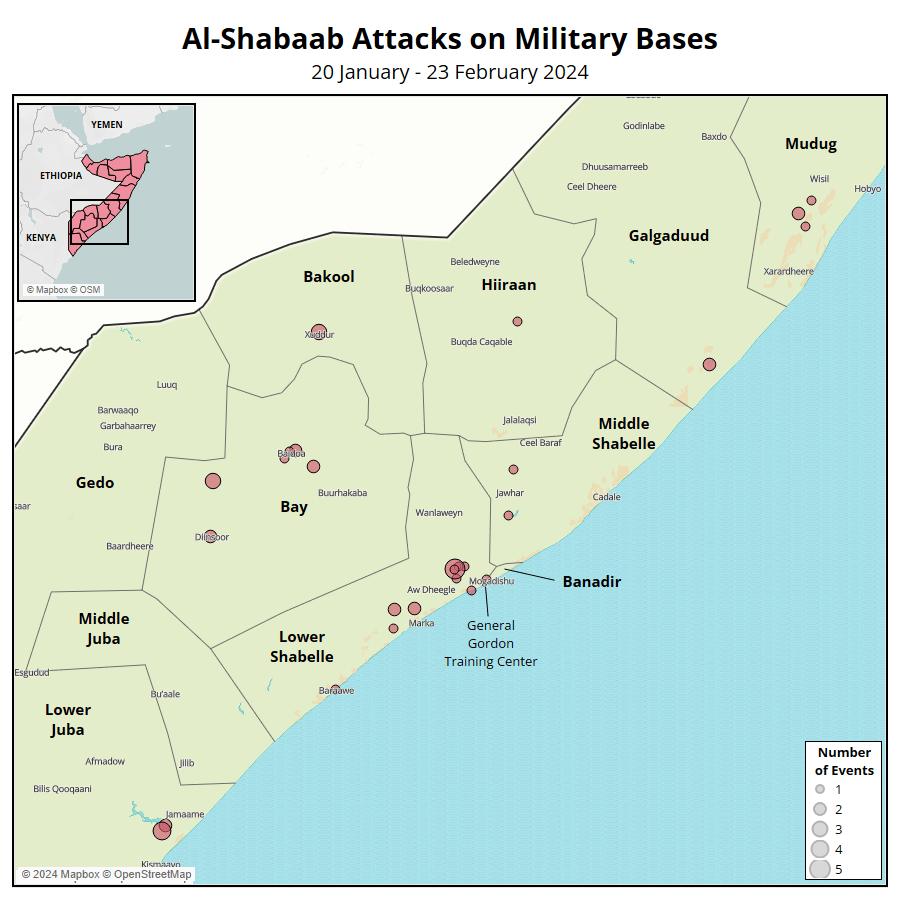
While the Somali National Army continued its large-scale campaign against al-Shabaab in Galmudug and Hirshabelle states, the militant group turned to attack army bases across central and southern Somalia. Most of these attacks were concentrated in Lower Shabelle, Bay, and Lower Juba regions, where the army has yet to begin its counter-insurgency operations (see map below). The most high-profile attack took place on 10 February in the capital, Mogadishu, where al-Shabaab claimed a raid on the General Gordon Training Center (GGTC). A man wearing a military uniform opened fire on senior military officials and instructors from the United Arab Emirates and Bahrain while they were praying. Eighteen soldiers, including three from the UAE and one from Bahrain, were reportedly killed, while 20 others, including two Emiratis, were injured.
The perpetrator of the deadly attack inside the GGTC defected from al-Shabaab and was recruited into the army but reportedly bypassed the formal vetting and reintegration process.1 Several members of parliament and local politicians actively endorsed the federal government’s drive to enlist recruits in an effort to support the counter-insurgency operation against al-Shabaab.2 This initiative created a system of ‘guarantors’ wherein all new recruits must have a local member of parliament or a minister as a guarantor. This process effectively suspends the formal security assessment conducted by the National Intelligence and Security Agency to determine whether the new recruits were or are affiliated with al-Shabaab.3 Normally, former militants are first moved to disarmament, demobilization, and reintegration (DDR) centers in Mogadishu and other areas for a mandatory training that lasts around one year. Only after completing this training are they allowed to join the security forces.4
As part of the local recruitment drive across the country, al-Shabaab militants surrendered to security forces in the last year in Hirshabelle, Galmudug, Southwest, and Jubaland. Among them was the perpetrator of the attack on the GGTC, who reportedly surrendered in Bay region and was recruited from Hudur town in Bakool region.5 Indeed, he never went to a DDR center but joined the army through the guarantor system.6
The expedited recruitment of former al-Shabaab fighters arguably provides an opportunity for al-Shabaab’s intelligence wing — the Amniyaat — to infiltrate military and security forces with its operatives.7 The 10 February attack is a testament to al-Shabaab’s reach and has caused embarrassment to the Somali government and its foreign backers. The UAE supports the Stabilization Unit forces, a Somali force that plays a vital role in securing the main streets of Mogadishu. This force was trained in Eritrea and returned to Somalia in late 2023.
In addition to infiltrating its forces into several government military bases, al-Shabaab has also attempted to recruit officers to conduct attacks against political and security targets. In mid-February, al-Shabaab’s intelligence wing reportedly communicated with a soldier in Afmadow town in Jubaland and promised him an unspecified amount of money to assassinate high-ranking military and government officials involved in the counter-insurgency operation. However, the soldier informed the Jubaland commander in Afmadow and Kismayo about the al-Shabaab plans, allowing security forces to foil the plot.8
One Year in to the Somaliland Conflict
January 2024 marked one year since fighting broke out between the Somaliland government and the SSC militia in January 2023. The conflict erupted after government security forces killed over a dozen demonstrators who were protesting against the assassination of an opposition party member in late December 2022. This is not the first time that these two actors have engaged in fighting: Other rounds of armed clashes also broke out between 2009 and 2014 in the SSC regions, amid two failed secessionist attempts from Somaliland. Though violence has largely subsided in Somaliland, tensions continue to run high in the SSC regions, as Somaliland government forces remained deployed in Cayn region as late as late January. Yet, the conflict shows no signs of abating, largely due to two main factors — funds and recognition of SSC regions administration by the Somali federal government — that were not present during the previous rounds of conflicts.
SSC militia members hail predominantly from the local Dhulbahante sub-clan of the Darod clan, which has long advocated for establishing an autonomous state under the federal government of Somalia rather than as part of an independent Somaliland administration.9 The Darod clan is one of the four majority clans in Somalia, alongside the Hawiye, Dir, and Rahanweyn/Digil-Mirifle. An autonomous SSC state recognized by the Somali federal government would thus allow the Dhulbahante to be accorded more seats in Mogadishu, while in Somaliland, where the Dhulbahante is recognized as a sub-clan of the Darod, it currently enjoys a minority status with limited political influence.
Laascaanood, the capital of Sool region, was the hotspot of the fighting between the Somaliland government forces and SSC militia in early 2023 (see graph below). Somaliland forces withdrew from Laascaanood in January 2023 and were swiftly replaced by the local SSC militia, which announced the establishment of the SSC-Khatumo transitional administration on 6 February 2023. Intermittent fighting continued until September 2023 and, after a short-lived lull, resurfaced in November.
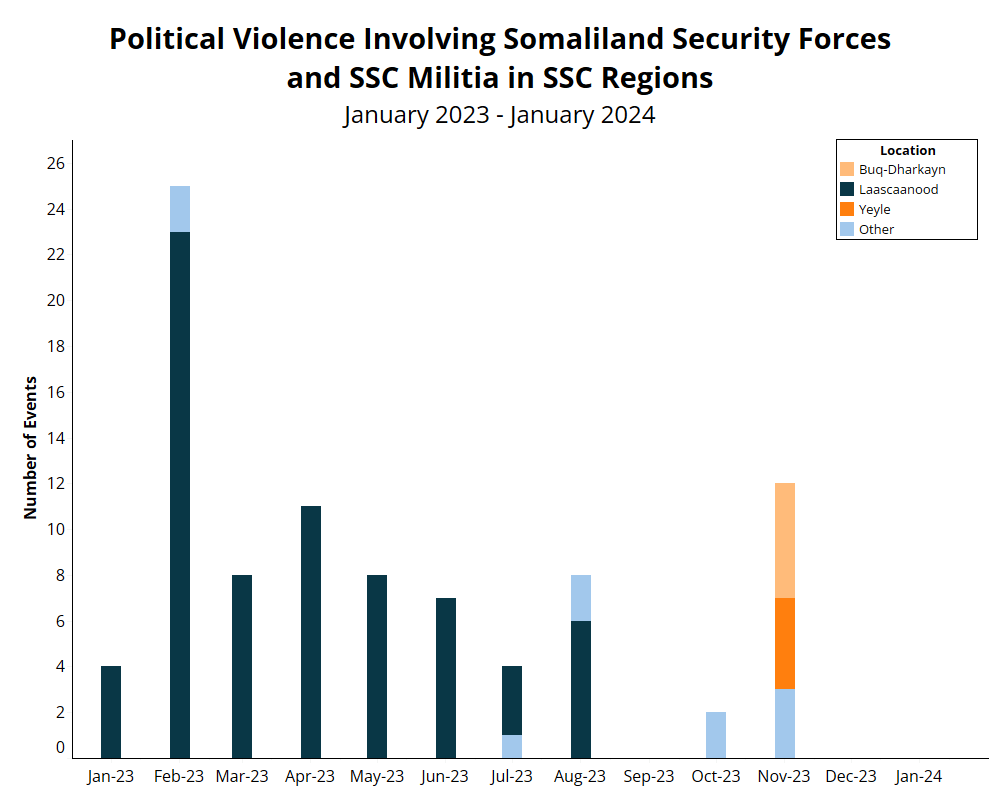 Toward the end of the year, armed clashes shifted in the direction of Buq-Dharkayn and Yeyle villages in Togdheer (Cayn) region. Buq-Dharkayn is situated some 25 kilometers away from Caynabo, a major city dominated by the Habar Jeclo sub-clan of the Isaaq clan. The prospect of Caynabo falling to the SSC militia raised concerns in the Somaliland government, where the Isaaq clan also exerts significant influence. Other sub-clans of the Isaaq were drawn into the conflict, with several Somaliland politicians attempting to mobilize loyal sub-clans against the SSC militia.10 On 25 January, the Somaliland government continued to deploy its forces near Buq-Dharkayn, indicating the persistence of the tensions into the new year. This is not the first time Dhulbahante elders have attempted to establish an autonomous administration under the federal government of Somalia. Since Somaliland announced its independence in May 1991, there have been at least two Dhulbahante-run local administrations — from October 2009 to 2011 and from 2012 to 2014 — characterized by intermittent clashes with Somaliland government forces. Both administrations failed to gain wider acceptance within the Dhulbahante sub-clan. They were also not accepted by Somaliland and by the then-Somali transitional government, and they eventually ceased to exist.11 Compared to the previous autonomous administrations, the 2023 SSC-Khatumo administration seems to have attracted wider acceptance among the Dhulbahante.12 Unlike the previous administrative attempts, the SSC breakaway government began to collect taxes in the SSC regions in November 2023, generating additional revenue for the administration, which otherwise primarily relies on the financial support of Darod clan members.13 Another success boasted by the SSC-Khatumo government is its administration over Laascaanood, a city that suffered economically due to the conflict between 2009 to 2014 and which the Dhulbahante aspired to revitalize. The federal government of Somalia also welcomed the creation of the transitional SSC-Khatumo administration, which was recognized by Mogadishu in October 2023.14 The move indicates the Somali government’s efforts to bring all breakaway territories under its federal authority, although this is at odds with Somaliland’s quest for international recognition.15 For over a decade, the governments of Somalia and Somaliland have tried to negotiate a diplomatic solution to the dispute over the statehood of these entities. In late December 2023, the two parties met in Djibouti and agreed to resume peace talks and discuss forming a single Somali government16; But this talk was halted after the news of the signing of a memorandum of understanding between Somaliland and Ethiopia, which would provide sea access to the latter. This reignited new tensions between the three actors – Somalia, Ethiopia, and Somaliland — as the Somali government rejected the agreement and accused Ethiopia of violating the territorial integrity of Somalia.
Footnotes
- 1
Garowe Online, ‘Hassan Mohamed: Who is the soldier who attacked General Gordan?’ 11 February 2024
- 2
- 3
- 4
- 5
Radio Daslan, ‘107 Al-Shabaab fighters surrender to Somali authorities,’ 8 September 2023
- 6
Garowe Online, ‘Hassan Mohamed: Who is the soldier who attacked General Gordan?, ‘ 11 February 2024
- 7
The Somali Digest, ‘Al-Shabab Infiltration Widespread in Mogadishu,’ 15 February 2024
- 8
- 9
- 10
- 11
Garowe Online, ‘Somalia: SSC-Khatumo will not be part of Puntland, elders say,’ 23 December 2023
- 12
- 13
- 14
- 15
- 16
Garowe Online, ‘Djibouti revives Somalia Govt’s talks with Somaliland,’ 28 December 2023


