
Ukraine Conflict Monitor
Update
Ukraine war situation update: 6 – 12 September 2025
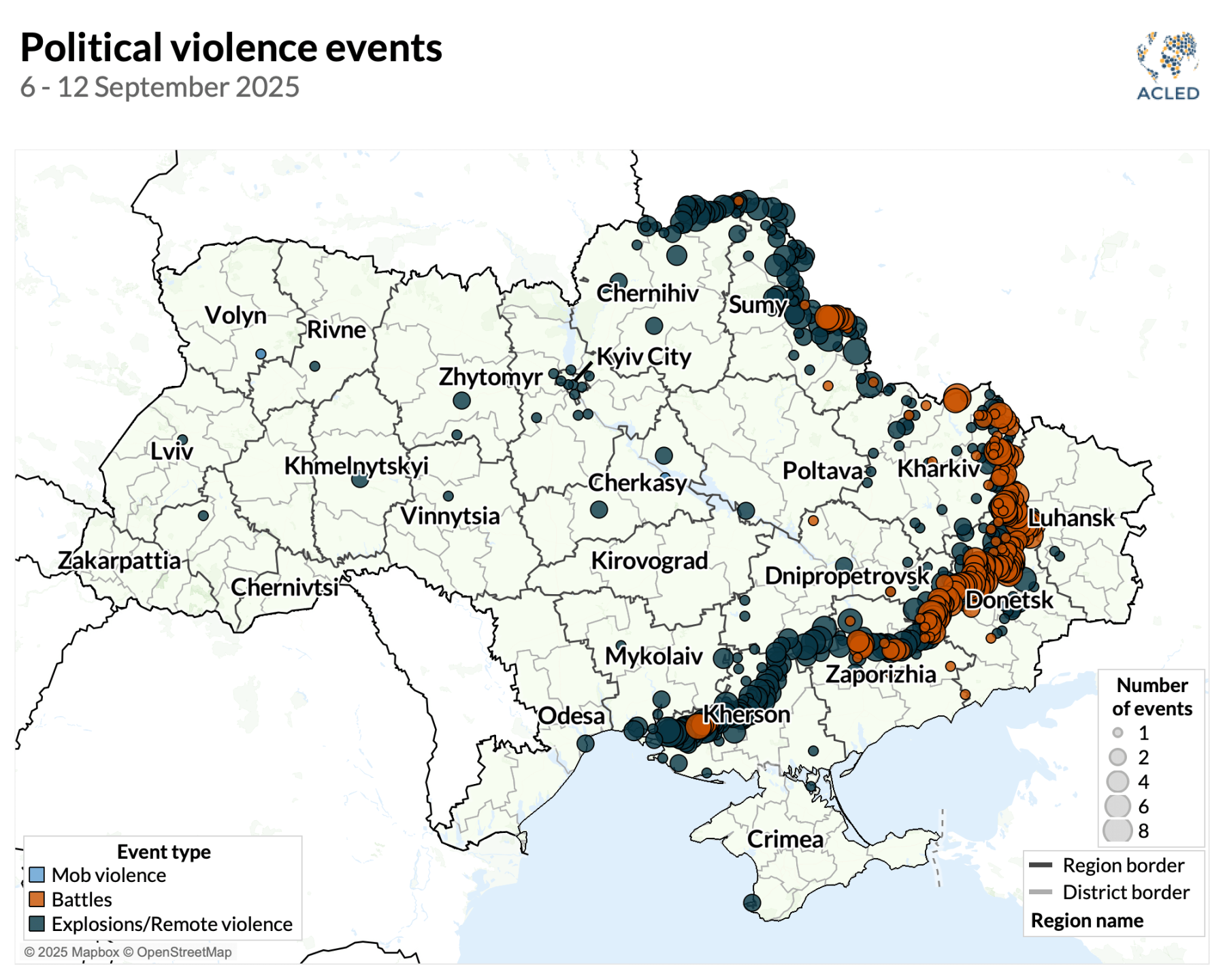
Overview of political violence and conflict events in Ukraine from 6 to 12 September 2025
Key stats

1,567 political violence events
5% increase compared to last week

132 incidents of violence targeting civilians
1% decrease compared to last week

At least 70 fatalities from civilian targeting
3% decrease compared to last week
Key events
-
7 Sep.
Kyiv — A Russian ballistic missile hits a government building in Kyiv city but fails to explode
-
9 Sep.
Donetsk — A Russian aerial bomb kills 25 Ukrainian retirees collecting pensions in Yarova
-
12 Sep.
Kharkiv — Reports emerge of Russian forces infiltrating Kupiansk via a non-functional gas pipeline
Key trends
- In the Dnipropetrovsk region at the junction with the Zaporizhia and Donetsk regions, Russian forces occupied two settlements, while Ukrainian forces regained one village.
- Ukrainian forces also regained control over a settlement northeast of Lyman in the Donetsk region.
- Russian forces launched at least 62 long-range missile and drone strikes, of which over a third affected the Dnipropetrovsk region. Other heavily affected areas were Kyiv city and the surrounding eponymous region and Zaporizhia city and its environs.
- Russian strikes killed at least 60 civilians in the Donetsk, Zaporizhia, Sumy, Chernihiv, Kharkiv, Dnipropetrovsk, and Zhytomyr regions, as well as in Kyiv city. Ukrainian strikes reportedly killed nine civilians in the Russia-occupied parts of the Kherson, Donetsk, Kharkiv, and Zaporizhia regions.
Spotlight: NATO engages Russian drones over Poland for the first time
During a Russian air raid on western Ukraine on the night of 9 and 10 September, 19 Russian decoy Shahed-type drones crossed into Poland from Belarus. Five of these were heading toward the Rzeszów airbase in southeastern Poland — a logistics hub that supplies Ukraine. Polish and allied forces scrambled military aircraft and activated ground-based air defense to intercept the drones and shot down four of them. The rest likely crashed after running out of fuel. One drone damaged a house in a Polish border area but caused no casualties. Several Polish airports were briefly locked down. At least two Russian drones also overflew Lithuania at the time of the incident. Russia claimed it did not target Poland, while Belarus said it warned Polish and Lithuanian counterparts of the looming incursion of stray drones and that it shot down some of them itself. Poland launched consultations within NATO, which avoided attributing the incident to intentional violation of allied airspace.1
The violation of Polish airspace occurred amid a Russian escalation of its offensive in eastern Ukraine and its heightened bombardment of the rest of the country, especially its capital, Kyiv, where a Russian ballistic missile hit the seat of Ukraine’s government in the same week. The sheer number and type of allegedly stray Russian drones crossing into Poland have raised suspicion of a deliberate incursion. It occurred days before the launch of the Russia-led Zapad military exercise in Belarus on 12 September, though the scale and relocation of the troops and equipment further away from Belarus’ western borders could be interpreted as a de-escalating move.2 On the eve of the incursion, Poland indefinitely closed all its land crossings with Belarus in response to the drill.3 Shortly after the incursion, NATO announced military deployments to Poland and other states on the alliance’s eastern border for undisclosed periods of time.4
ACLED data show about 50 aerial incursions into countries on or near Ukraine’s western borders since the start of Russia’s all-out invasion of Ukraine. These include overflights and crashes of projectiles operated by both Russia and Ukraine. In the most serious incident, a Ukrainian interceptor missile killed two Polish civilians in November 2022 in a border area while fending off a Russian air raid. The overwhelming majority of incidents occurred in Moldova and Romania, including a Russian attack drone that overflew Romania’s territory for about an hour before returning to Ukraine on 13 September. Romanian authorities shared that fighter jet pilots chose not to engage it to minimize the risk of collateral damage.5 The majority of such incidents, however, occurred in the context of Russian bombardments of Ukraine’s grain and port infrastructure following Moscow’s departure from the Black Sea Grain Initiative in July 2023, including at the junction of the three countries’ borders in the Danube River delta area.
Explore the ACLED Conflict Exposure Calculator to assess the numbers of people affected by armed violence, disaggregated by locations, time period, and actors involved.


