
Report
Between an ICC trial and the 2028 polls, the Dutertes’ shifting fortunes are shaping the Philippine war on drugs
A close look at ACLED’s data on the Philippines’ continuing war on drugs and how it has been shaped by elections, international pressure, and the power struggle between the Duterte and Marcos political dynasties.

Key takeaways
- ACLED records at least 7,980 civilian deaths related to former President Rodrigo Duterte’s war on drugs between 30 June 2016 to 29 June 2022, the period spanning his term.
- The war on drugs was sensitive to political developments. The ICC prosecutor’s formal request to investigate the war on drugs was followed by a marked decline in violence in 2021, succeeding earlier declines amid public outcry.
- Under President Ferdinand “Bongbong” Marcos Jr., the war on drugs has continued in the absence of any definitive break from the Duterte-era policy, killing at least 492 civilians from 30 June 2022 to 10 October 2025.
- Central Visayas has emerged as the center of gravity of drug-related violence under Marcos Jr. Meanwhile, Davao Region — which saw Davao City Mayor Sebastian Duterte launching his own war on drugs in 2024 — now leads in drug-related police violence against civilians.
- The war on drugs is tied to the bitter feud between the previously allied Duterte and Marcos families. Rodrigo Duterte’s ICC arrest in March 2025 saw Marcos Jr. weakened in the 2025 midterm polls that followed, bolstering Vice President Sara Duterte’s position ahead of the 2028 presidential election.
Methodology
For more information see our methodology article: Philippines “War on Drugs”
A body floats on the murky waters of a canal in the gritty back alleys of the Navotas fishing port, Manila’s largest. The bustling market stands on the northern part of Manila Bay, close to some of the city’s poorest neighborhoods.
It is unclear how much time had passed before the body of Marcelino “Tiki” Estrada Jr. was found there on 27 September 2019, head bloodied, throat cut, and stabbed multiple times.1 Had it not been found, the 17-year-old’s body might have floated seaward toward the adjacent Manila Bay, carried along by the city’s waste.
Estrada was one of thousands whose cadavers would litter Philippine cities in an unprecedented war on drugs. Four years earlier, in May 2015, as rumors stirred about his possible run for the presidency, Rodrigo Duterte coyly warned voters not to toy with the idea of giving him power. By then, Human Rights Watch had already accused him of summarily executing nearly a thousand people during his notorious tenure as the mayor of Davao City for over two decades.2 If he became president, Duterte said on a radio show, that number would rise to 100,000. “You will see the fish get fat in Manila Bay — that’s where I will dump you.”3
That threat soon became the promise of Duterte’s 2016 election campaign, during which his violent rhetoric led him to surge past previous favorites. He then handily beat nationally prominent frontrunners from his southern perch.4 What followed was a bloodbath unparalleled in recent Philippine history.
It has been close to a decade since Duterte’s war on drugs exploded onto the national scene when he became president on 30 June 2016. And it has now been a few years since he left office. Now, Duterte has traded Malacañang Palace for Scheveningen Prison at The Hague, where he is detained to face crimes against humanity charges at the International Criminal Court (ICC). For victims of his war, the ICC proceedings at once promise a semblance of justice, but also offer Duterte the due process that was never afforded to them.
ACLED closely followed the Duterte-era war on drugs at its height, listing every reported incident and casualty every week. It continues to follow the country’s war on drugs to this day. As Duterte faces trial at the ICC, ACLED is looking back at the long years of this war, as well as forward at how this bloody legacy continues to shape the country’s political future. In the face of a looming 2028 presidential showdown between the Marcos and Duterte families, a quieter drug war lives on, and political gains continue to be paid in blood.
A landslide electoral victory drove an early peak in Duterte’s drug war
One would be hard-pressed to think of other examples in Philippine history than Duterte’s war on drugs that can trace as direct a line from word to bullet. Duterte’s 2016 campaign promised a blistering war that would chase away the scourge of drugs and crime in “three to six months” — his awe-inspiring campaign refrain.5 When Duterte took office on 30 June 2016, the marching orders of the boots on the ground were clear.
ACLED began recording data on drug-related violence in the Philippines on 1 January 2016. From 30 June 2016 to 29 June 2022, the period spanning Duterte’s term, ACLED records at least 7,980 drug war-related civilian deaths. His assumption of the presidency was marked by an extreme surge in violent drug-related events, constituting an early peak in his six-year war on drugs. In the first month of Duterte’s term alone, ACLED records at least 829 civilian deaths.
Drug-related violence in the Philippines rose from 104 events between January and June 2016 to over 2,200 between July and December of the same year, Duterte’s first six months in office. Noticeably, however, the floodgates of violence started opening in May 2016, in the aftermath of Duterte’s landslide election victory on 9 May.
ACLED maintains a broader dataset of all war on drugs-related violence beyond attacks on civilians, amounting to 6,974 events and at least 9,200 reported fatalities between January 2016 and September 2025 (see chart below). This broader dataset also includes events coded by ACLED as armed clashes between armed drug suspects and other armed actors, such as state forces and anti-drug vigilantes. While ACLED does not include these armed clashes in the narrower count of violent events against civilians in accordance with its wider methodology, the armed drug suspects in such cases may still meet the legal definition of “civilian.”

The bloodbath was unprecedented. In 2018, ACLED compared the situation in the Philippines to a “war zone in disguise,” earning the ire of palace officials in the process.6 And yet the comparison was apt: One would have to go back decades to find comparable mass death events in the Philippines in such a concentrated period of time. Duterte’s war on drugs dwarfs even the military’s war with Islamic State-inspired militants during their months-long siege on Marawi City in 2017, which has been deemed the bloodiest Philippine military operation since World War II, with at least 1,100 fatalities.7
The deal that Duterte offered the electorate in 2016 was essentially to bring a killing machine he perfected in Davao City to every part of the country. So when Duterte traded the Davao City Hall for Malacañang Palace in the capital, the violence followed him north.
While the center of gravity of the war on drugs changed throughout Duterte’s term, its first epicenter was the National Capital Region around Manila, also known as Metro Manila (see map below). Overall, Metro Manila recorded the highest levels of drug-related violence across Duterte’s entire term. However, Central Luzon later took on a higher share of the violence, which journalists and human rights groups attributed to the reassignment of many high-ranking police officers to Central Luzon — particularly the province of Bulacan — as relentless scrutiny focused on Manila (see map below).8

Interestingly, Davao City itself, as well as the larger Davao Region around it (see map above), was spared the worst of the violence, despite being the birthplace of the Davao Death Squad, whose extrajudicial killings in Davao City under then-mayor Duterte’s leadership first brought him notoriety. That said, Duterte’s legendary time as mayor resonated across the country, in Davao City and elsewhere. Duterte’s following became a cultural juggernaut and self-identified as the DDS — short for Diehard Duterte Supporters, notably sharing its initials with the Davao Death Squad.9 Nevertheless, the actual Davao Death Squad also found itself emulated across the country. The overwhelming bulk of the data shows that thousands of drug suspects were killed principally by two actors: police forces — including both the Philippine National Police (PNP) and the specialized Philippine Drug Enforcement Agency (PDEA) — and anti-drug vigilantes. However, the proportion of police-perpetrated and vigilante-style attacks also varied in each region (see chart below). In Metro Manila, for example, roughly half of such violence was perpetrated by police, and half by anti-drug vigilantes, while towns and cities in Central Luzon became killing fields virtually at the mercy of police.

In fact, the explosive introduction of the war on drugs in Manila was a direct result of Duterte hand-plucking his most trusted police lieutenants and bringing them into national posts.10 Apart from police and anti-drug vigilantes, however, other armed forces also became involved in the violence. While a handful of events involved the military (notably in BARMM, the Bangsamoro Autonomous Region in Muslim Mindanao), some non-state armed groups also played their part as diverse political classes tested the waters. The Moro Islamic Liberation Front (MILF) offered its assistance in Mindanao.11 Even the communist rebels played a small part in the frenzy,12 as Duterte initially made accommodations for leftist politicians.13 Consequently, 3% of war on drugs-related violent events targeting civilians were perpetrated by neither police nor anti-drug vigilantes under Duterte.
The larger part — 61% — of these attacks on drug suspects that were carried out by neither police forces nor anti-drug vigilantes, however, were carried out by other drug suspects. While such violence falls outside the narrower phenomenon of state- or state-sponsored targeting of drug suspects and often shares the characteristics of more ordinary drug-related crime, ACLED covers these events as part of its broader dataset in recognition of the fact that the Duterte anti-drug campaign started a larger conflagration of drug-related violence.
Methodology
For example, some drug suspects attacked other drug suspects on suspicion that the latter were police informants. In some cases, this general chaos was also instrumentalized for outright financial gain. Opportunities abounded for entrepreneurial police officers, lured by the easy money of extortion. “For-profit” police abductions spawned makeshift jails in police stations.14
The violence seemed to touch the full breadth and scope of Philippine society. Gunshots rang out in the city’s poorest slums,15 in surf resorts,16 in remote farming communities,17 even at sea.18 Despite the diversity of settings, however, the violence overwhelmingly targeted the poor.19
The war on drugs took the lives not solely of drug suspects (regardless of the credibility of the accusation), but also of drug suspects’ relatives, children, and even those seemingly on the side of the government’s effort: anti-drug advocates and police informants. Even Duterte supporters were killed, including the very young.20 There are also cases where drug accusations were wielded as a pretext for attacks on individuals presumably targeted for unrelated reasons (see visual below).21
The case of Marcelino “Tiki” Estrada Jr., the 17-year-old found lifeless in a canal, is emblematic of much of the violence that transpired. Like in many instances of violence against civilians during the height of Duterte’s war, many details of Estrada’s killing were unclear: Was he a drug suspect, just like his parents, who were in jail for drug offenses, or his friend, who was killed by police in a supposed drug sting a few days earlier? Or was he a police informant, as some neighbors suspected? Was his killing perpetrated by vigilantes?
Some things, on the other hand, were clear: He was a minor, among the many killed in the war on drugs, and he lived in an impoverished neighborhood.
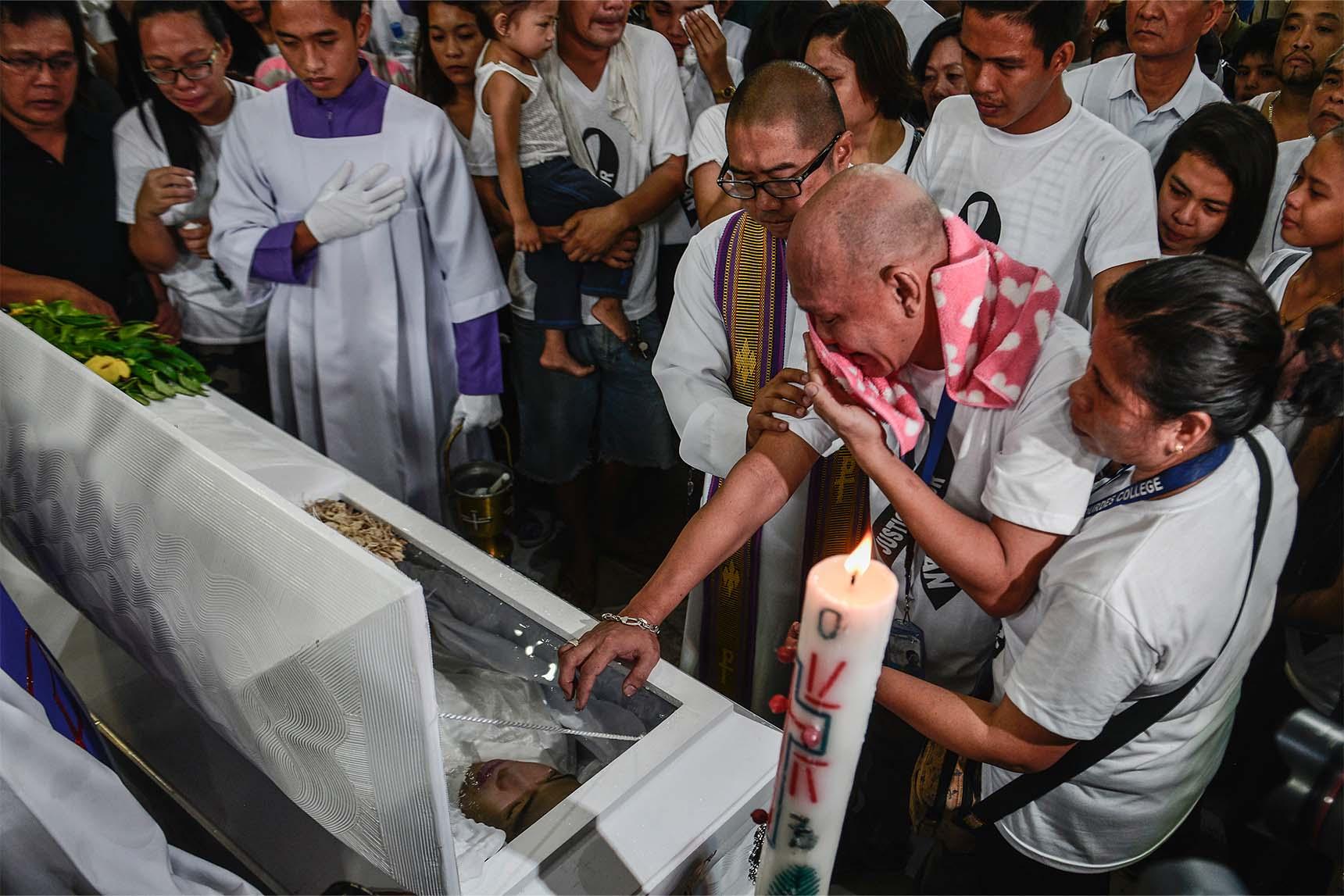
The parents and relatives of Kian Loyd Delos Santos weep over his coffin during his funeral rites in Caloocan, Metro Manila, Philippines, 26 August 2017.
Photo by Ezra Acayan/NurPhoto via Getty Images
The list of reported fatalities grew longer and longer. By February 2017, counting had become so difficult that the most well-known early running list of the dead, the Philippine Daily Inquirer’s “Kill List,” stopped being updated.22 And with such large numbers, disagreements soon erupted on how to even properly count the dead (for a detailed discussion on the difficulties of counting the deaths from the war on drugs, see this previous ACLED analysis). Nonetheless, as a now global view of Duterte’s full six years in power reveals, the killings never stopped.
Duterte’s war on drugs rode on high public support but provoked tireless opposition
The war on drugs was partly brought about by savvy political calculation that guaranteed Duterte’s path to the presidency. When Duterte finally announced his presidential run in December 2015 after playing coy for months, he was already speaking in terms of inevitabilities, releasing a memorable Christmas greeting wishing drug users a Merry Christmas — as it would be their last.
As his notoriety grew, he cultivated the image of a swashbuckling crusader in media appearances, as immortalized in a magazine cover by Esquire Philippines in 2016.23 His team also used social media in unprecedented ways. Controversial consultancy Cambridge Analytica later turned out to have helped market Duterte as a tough crime fighter when it used the Philippines as a “petri dish” to test out the efficacy of its social media operations in swaying elections.24 Duterte’s attentiveness to popular sentiment bore results. Within a year and a half, between the initial buzz surrounding Duterte’s possible run in June 2015 and the six-month mark of Duterte’s presidency in December 2016, opinion polls showed that the number of Filipinos who ranked fighting criminality as among their most urgent national concerns had risen by 13 percentage points to 33% from 20%. The increase in public concern for criminality came as Duterte relentlessly drummed up noise about crime as he transitioned from underdog presidential candidate to landslide election victor.
And it was precisely on the issue of criminality that the freshly installed Duterte administration had the highest net approval rating of +80, or 84% approval versus 4% disapproval. In comparison, the preceding Aquino regime had a far more modest approval rating of +23 for fighting criminality in December 2015 (45% approval, 22% disapproval).25
For Duterte, these could not have been anything but unambiguous signs of high public support for his agenda, giving him carte blanche to wage his war as he saw fit. His electoral mandate was consistently affirmed throughout his term through consistently high approval ratings. As multiple opinion polls confirmed, Duterte ended his term with record-high approval ratings — and as the most popular president of the Philippines by far since the end of the late dictator Ferdinand Marcos Sr.’s rule in 1986.26
Human rights groups and activists led the charge against Duterte
Nevertheless, the opposition to Duterte’s war on drugs was loud and relentless from the very start. As DDS influencers rabble-roused online in support of the president’s agenda,27 opposition stalwarts raised hell in a hostile congress while committed activists took to the streets, despite the often lethal threat of being red-tagged as communists (for more on the deadly practice of red-tagging in the Philippines, see this previous ACLED report). It was clear to Duterte that the support of the majority should not slacken his political calculation and impair his view of risks. Throughout his term, therefore, the development of the war on drugs reflected the relentless campaigns by the opposition and activist groups to hold him to account.
With the dust barely settling from the shock and awe of the explosive first month of the war on drugs and long before any prospect of an ICC case, the Senate of the Philippines began an investigation into the war, which would feature testimonies of self-confessed assassins of the Davao Death Squad, such as Edgar Matobato. The firestorm was brought to a halt when Leila de Lima, the senator leading the investigation as head of the Senate Committee on Justice and Human Rights, was ousted by her colleagues from the committee in favor of an administration-aligned senator, Richard Gordon. The senate investigation was then wrapped up by October, when it was declared that the drug-related killings — then having reached 2,216 by ACLED’s count as of September 2016 — were not state-sponsored.28 By February 2017, de Lima, who Duterte has loathed since his mayorship in Davao City due to her scrutiny of the Davao Death Squad when she was chair of the Commission on Human Rights, was arrested on drug-related charges in a highly politicized case that human rights groups have termed political persecution. The senator spent over six years in jail before being freed on bail in November 2023 and finally acquitted in June 2024, after Duterte’s term.29
Still, the outcry provoked by the truncated senate hearing on the war on drugs was not yet enough to arrest its momentum. It was proceeding at full steam. On paper, the war on drugs was carried out through the police’s operational plan (Oplan) Double Barrel. It comprised two components: Oplan Tokhang, which focused on street-level drug suspects and literally meant “knock and plead” (as in to knock on the doors of drug suspects and plead that they give up their illegal drug activity), and Oplan HVT, which targeted “high-value targets.” Oplan Tokhang was by far the more prominent and notorious of the two operations, and “tokhang” became synonymous with the terror of the war.
For the early developments of the war on drugs under Duterte and its operational features, see this ACLED analysis from 2018.
In 2017, outcry over the violence of Oplan Tokhang and relentless political campaigning by the opposition yielded some begrudging concessions from Duterte. After the sensational police killing of a South Korean businessman, ostensibly in the context of the war on drugs but later revealed to be a mere extortion racket,30 the larger police force — the PNP — was excluded from anti-drug operations for a month in January. Instead, PDEA, a security force designed specifically to wage anti-drug operations and directly under the office of the president, was tasked with overseeing and implementing the war on drugs on its own. After that month-long pause, Duterte announced a longer-term exclusion of the PNP from anti-drug operations in October 2017. Duterte said he hoped that this would satisfy the “bleeding hearts,” as he so often called his critics.31
There was an immediate drop in war on drugs-related events in both periods when the PNP was not a protagonist in the drug war. But these respites never lasted long. Upon protestations from his security officials, including PNP chief Bato dela Rosa,32 the PNP was again “reactivated” as a primary participant in the war on drugs by December 2017.33 The killings predictably rose again soon after (see chart below).

The two periods of PNP exclusion from the war on drugs clearly showed drops in police attacks against drug suspects. Both pauses were also followed by a clear rebound in attacks once PNP participation was reactivated. Curiously, anti-drug vigilante attacks on drug suspects also dropped notably during the same periods of PNP exclusion. However, after the second PNP pause from October to December 2017, anti-drug vigilante attacks no longer rebounded to track PNP violence, instead falling off definitively from its earlier peaks. While the coincident drop in police and vigilante attacks on drug suspects during the period of official PNP exclusion from the war on drugs aligns with the claim that police and anti-drug vigilantes coordinated their efforts, as alleged by human rights groups,34 the drop in anti-drug vigilante attacks in later years may point to the government’s desire to keep a tighter leash on the war in its later stages, as ACLED previously argued.
Regardless of the fluctuating levels of police and vigilante involvement in the drug war, however, the overwhelming majority of events were one-sided attacks on civilians, rather than armed clashes (see chart below). This challenges the persistent government “nanlaban” narrative — literally, “to have fought back” — that asserted most war on drug-related killings were the result of police self-defense against drug suspects who were violently resisting arrest.35

Mounting international scrutiny kept the pressure on Duterte
With the opposition facing limited success and increasingly fewer options at home, they soon directed their gaze toward international law. As friendly international voices echoed domestic condemnation of the war on drugs, Duterte developed a particular animosity for his international critics. He had choice words for ICC prosecutor Fatou Bensouda and other international officials, such as then United Nations special rapporteur Agnès Callamard: “don’t f— with me, girls.”36 He also liked to deride — incorrectly — the ICC as an all-white body and branded it a creation of the European Union.37 Still, his insults in front of the cameras were matched by prudent moves behind the scenes.
Duterte’s insults could not stop a barrage of international legal challenges. In April 2017, a Filipino lawyer representing Matobato filed the first complaint over Duterte’s war on drugs at the ICC. This was followed by another complaint in June 2017 by opposition lawmakers.38
In February 2018 came the bombshell. Bensouda said her office was launching a preliminary investigation into the situation in the Philippines.39 Duterte was apoplectic and threatened Bensouda with arrest if she came to the Philippines.40 A month later, on 14 March 2018, the Philippines announced its withdrawal from the Rome Statute that established the ICC.41 In accordance with the statute, the withdrawal only took effect a year later, on 17 March 2019.42
As the ICC has asserted, however, the Philippines’ withdrawal did not affect the court’s jurisdiction over crimes committed when the Philippines was still a party to the court. This explains why the current ICC case covers 1 November 2011 to 16 March 2019, spanning the time of Duterte’s mayorship in Davao City to the first half of his presidency.43
As the ICC was conducting its preliminary investigation without any cooperation and even amid threats from the government, victims of the war on drugs and activist groups filed a third complaint against Duterte at the court in August 2018.44
At this stage, the opposition and activist groups were also seeking intervention from the UN, notably the Geneva-based UN Human Rights Council (UNHRC). This led the UNHRC to direct the Office of the UN High Commissioner for Human Rights (OHCHR) to investigate the situation in the Philippines. The resulting OHCHR report, published in June 2020, connected rights violations in the conduct of the war on drugs to Duterte’s rhetoric and noted the inability of domestic mechanisms to ensure accountability.45
In the wake of the OHCHR report, the Philippines made its most direct response to the growing international pressure, not least of which to the announced ICC preliminary investigation. On 30 June 2020, at the 44th session of the UNHRC, Philippine Department of Justice (DOJ) Secretary Menardo Guevarra announced a top-level review of the war on drugs.46
Guevarra, acting under the orders of Duterte, openly admitted that the review was designed to eliminate the need for the ICC investigation.47 If the Philippine government were to foreclose the prospect of an international tribunal targeting the orchestrators of the war on drugs, it needed to prove that the country’s justice system was functional enough to secure this accountability.
For all its fanfare, the DOJ review had no significant impact on the volume of violent war on drugs-related events, which fluctuated back up in January and May 2021. In 2020, the year the DOJ review began, drug war violence averaged 46 events per month. This is only slightly lower than the previous year’s monthly average of 55.
It was another decisive development at the ICC that showed a more discernible impact on war on drugs-related violence. On 14 June 2021, following years of preliminary investigation and on the eve of her retirement, Bensouda published her request for ICC authorization to launch a full investigation into the situation in the Philippines.48 Suddenly, the prospect of an ICC trial became very real, and the perpetrators of drug war violence seemed adequately spooked. Compared to the three months prior, the volume of drug war events fell by 57% in the three months that followed the publication of the ICC prosecutor’s request and would never rise to levels seen previously (see chart below). The average number of such events fell to 32 per month in 2021. On 15 September 2021, the ICC officially approved the prosecutor’s request.49 The full investigation began.

While the Philippine government asserted that it would not cooperate with the ICC, it nevertheless filed a petition asking that the ICC halt its investigation, citing, among other reasons, the DOJ review.50 This led to a temporary deferral of the investigation. However, in its response to the Philippine government’s petition, the ICC prosecutor blasted the DOJ review and other government efforts to ensure accountability as woefully inadequate.51
At the time the DOJ review was launched, the government itself had admitted that 5,722 deaths related to its war on drugs had taken place as of 31 May 2020, based on its #RealNumbersPH social media campaign meant to challenge higher death tolls.52 The DOJ review investigated a minuscule fraction of this figure, submitting two reports to Duterte that investigated 300 and 52 cases, respectively. The full contents of the reports were kept secret, though in October 2021, the DOJ publicly released a barebones matrix containing key information on the 52 cases reviewed in the second report. However, the DOJ did not directly prosecute cases and file criminal complaints after the review, instead only further referring relevant cases to the National Bureau of Investigation for “case buildup.”53
In fact, of the thousands of government-acknowledged killings by police related to the war on drugs, there had only been one single conviction of a police officer during Duterte’s term, in a judgment handed out in 2018. The next conviction was made only in November 2022, after Duterte’s term. The latest conviction, in September 2025, was only the fifth.54
Additionally, on top of the Philippine justice system’s snail-paced prosecution of perpetrators, the million-dollar question for the supposedly impartial review was: Would Duterte’s own DOJ prosecute Duterte himself?55
Years later, in 2025, the same DOJ under Duterte’s successor, President Ferdinand “Bongbong” Marcos Jr., admitted that the Philippine justice system was unable to secure accountability for the war on drugs due to destroyed or absent evidence, effectively ceding the prosecution of crimes to the ICC.56
While the war on drugs continues under Marcos, it remains a rallying point for Duterte’s base
The war on drugs was the centerpiece of a breathtaking political phenomenon that the Marcoses saw as a convenient ride to Malacañang. ACLED data show that the war on drugs under Marcos has continued at a rate comparable to the final Duterte years, so far amounting to at least 492 drug war-related civilian deaths up to 10 October 2025. In fact, while Marcos has made a show of seeking to wage a “bloodless” war on drugs,57 there was a slight increase in war on drugs-related violence during his first year in office versus Duterte’s last year. While there has been a gradual drop in such violence since Marcos’s first year, the levels of violence are comparable to Duterte’s last months in power. Now, under Marcos, new patterns of violence are instead emerging. In particular, the center of gravity has moved to Central Visayas,58 especially Cebu, a strongly Duterte-supportive province (see map below).59

The overwhelming bulk of perpetrators of violence against drug suspects remains the police. However, anti-drug vigilantes are also playing a significant role in the violence in Central Visayas. Compared to the Duterte years, there is also a marked increase in the proportional share of violent activity by armed drug suspects, also notably in Central Visayas (see chart below).

The ambivalent posture of the Marcos government on the war on drugs draws from a mismatch in word and deed. Despite Marcos’s much-touted “bloodless” war on drugs, the basic legal framework of the government’s anti-drug efforts has remained the same for decades. It is backed up by the same laws, particularly the Comprehensive Dangerous Drugs Act of 2002 (RA 9165), and it relies on the same implementing bodies, namely the PNP and PDEA. It is worth pointing out that Marcos never officially terminated the Duterte-era Oplan Double Barrel, the very operational plan that put Duterte’s war on drugs into action. Oplan Double Barrel’s last iteration, called Oplan Double Barrel Finale: Anti-Illegal Drugs Operation through Reinforcement and Education (ADORE), was launched in 2022 in Duterte’s final months in office and remains in force under Marcos.60 At this rate, it seems like Marcos’s war on drugs will survive even the very public and messy political divorce between the Marcoses and the Dutertes.
Nothing about this divorce seemed preordained in 2016, when Marcos Jr.’s long path to Malacañang depended on securing Duterte’s support. It took a funeral to finally confirm the marriage of convenience between the Dutertes and the Marcoses. In November 2016, the newly installed President Duterte granted the decades-long wish of the Marcos family for a hero’s burial for the late dictator Ferdinand Marcos Sr. at the Libingan ng mga Bayani, the national heroes’ cemetery.61
Nevertheless, Duterte always seemed to understand that his popularity was no guarantee that he would be protected from political costs once out of power — and he also never seemed to trust the Marcoses. Thus, when the scramble for the 2022 elections began, the elder Duterte was publicly irate at his daughter Sara Zimmerman Duterte for not seeking the presidency despite her status as an early frontrunner. Instead, an independent-minded Sara gave in to Marcos Jr.’s dogged pursuit and agreed to be his running mate, rebuffing her incredulous father.62 It was a winning formula: The Marcos-Duterte tandem won by a landslide.63
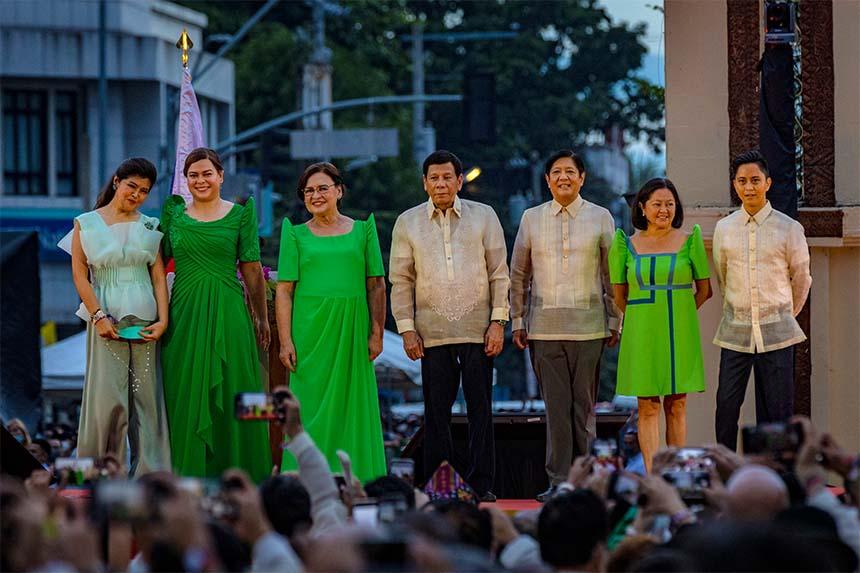
The Duterte and Marcos families pose for pictures during the oathtaking of Sara Duterte as the next vice president on 19 June 2022 in Davao, Philippines.
Photo: Ezra Acayan/Getty Images
Yet the zero-sum nature of the relationship between the two families became increasingly evident. In their first year of ruling together after their 2022 victory, the tensions simmered quietly amid signs of a gap, such as Marcos not giving Sara Duterte the defense portfolio she publicly coveted.64 When the tensions boiled over, the public witnessed a quick succession of increasingly acrimonious fighting. If at first it was First Lady Louise Araneta-Marcos saying she resented Sara Duterte for laughing when Rodrigo Duterte made a drug-related joke about Marcos Jr.,65 soon it was Sara Duterte threatening to dig up Marcos Sr.’s body and throw it into the West Philippine Sea.66 By that point, it was only a matter of time before she threatened to have Marcos Jr. assassinated.67
The subtext to all this, of course, is presidential succession in 2028. If the implicit understanding in 2022 was that Sara Duterte would succeed Marcos Jr., who is constitutionally limited to a single term, this prospect seemed quickly thrown out the window.68 Marcos’ allies in the House of Representatives were thus quick to pounce when Sara Duterte made the assassination threat, voting to impeach her not only over the threatened assassination but also over other issues such as the alleged anomalous use of confidential funds as claimed by leftist lawmakers.69 Notably, conviction in an impeachment would have carried a heavy penalty: perpetual disqualification from public office.
As the Marcos-Duterte alliance broke down in spectacular fashion, however, the war on drugs raged on. Soon enough, journalists and human rights organizations discredited Marcos’ claims of a “bloodless” anti-drug strategy.70 As ACLED data show, drug suspects continued to be killed en masse under his watch.
In this context, the war on drugs continued to lend itself to political instrumentalization. The Dutertes knew this better than anyone, as was starkly demonstrated in Sebastian Duterte’s attempt to launch his own mini war. On 22 March 2024, Sebastian Duterte, Rodrigo Duterte’s youngest son, who has served as Davao City mayor since 2022, went on an angry tirade against drugs and publicly announced his own war on drugs in the city.71 This led to immediate bloodshed. Seven drug suspects were killed around Davao City from 23 to 26 March.72
Recognizing the situation as a test of his credibility, Marcos moved decisively to neutralize the Davao City operation, and a bevy of police suspensions and reassignments soon followed. That following May, the national police leadership removed the police chief of Davao City and 34 other police officers in connection with the killings.73
Nevertheless, the episode illustrated that the legacy of the war on drugs is intimately tied to the Dutertes’ political fortunes — not least of which in 2028. Sebastian Duterte’s defanged war on drugs was just one in a growing list of signs that the Dutertes were being backed into a corner by the Marcoses as the latter moved to secure their position for 2028. The House of Representatives, dominated by Marcos allies, also started a new inquiry into Rodrigo Duterte’s war on drugs in late 2024, leading to explosive testimonies — including from Duterte himself, who admitted to having a death squad.74 And, of course, the clincher was the House vote to impeach Sara Duterte in December 2024.
But all these blows paled in comparison to the one that came in the early morning of 11 March 2025, as the campaign period for the 2025 midterm elections was in full swing. Rodrigo Duterte was on a flight home from Hong Kong, where he had just campaigned before the overseas Filipino community on behalf of his allies.
As Cathay Pacific flight CX 907 carrying Duterte made the short hop from Hong Kong to Manila, 300 police officers had assembled at the airport ahead of the former president’s arrival.75 Overnight, Interpol had transmitted the ICC warrant of arrest against Duterte for crimes against humanity, and Marcos directed the PNP to serve it against their former commander-in-chief.
The rumors of the arrest had been swirling for days. Duterte himself mentioned it in Hong Kong and had previously taunted the ICC to hurry up. But when Duterte was met by police in the airport at around 10:00 a.m., he dared them to kill him instead, as he would not accept arrest by police officers doing the bidding of “those whites.”76 The whole-day affair, with wall-to-wall coverage playing on screens across the country, was marked by uncertainty over how the arrest would play out and where Duterte would be brought. The DDS, in tears, trooped to the airport.77 The hours-long standoff, however, was ultimately unable to stop the unstoppable.78
After over eight hours, Duterte boarded a Gulfstream 550 for The Hague with his lawyer, nurses, and police officials. After some further delay, the jet finally took off from the airport at 11:03 p.m. Cutting a lonesome figure in the night sky, the aircraft slowly vanished as it headed west over Manila Bay. In video footage of the departure from the tarmac, unknown voices are heard cheering.79
Duterte’s war on drugs looms over the 2028 elections
The ICC arrest was a development at once embedded in the political rhythms of the country, yet also removed from it. The court was no deus ex machina. The case was the result of a nearly decade-long effort by tireless opposition and activist groups, including the survivors of the war on drugs themselves, to hold Duterte accountable for the killings committed under his watch.
To be clear, Marcos, Jr. and his allies had no role in the effort to build the case against Duterte at the ICC. Marcos did not only reject cooperation with the ICC; he also chose to ally with the Dutertes and reap its rewards.80 At the same time, there is no denying that the Duterte arrest was a card that fell on Marcos’s lap, which he consequently chose to play. In this way, this most extraordinary event became anchored to the three-year cycles of Philippine elections.
But nothing is ever certain for long in Philippine politics. Marcos himself knows that ruling families chased out of the country can return triumphantly to Malacañang. So even though it appeared that the ultimate political cost had arrived for the Dutertes, signs are emerging that the Dutertes have begun to turn defeat into opportunity. Duterte’s arrest fired up the Duterte base like no other blow from the Marcoses before it and allowed Duterte allies to power their way to a dominant showing in the 2025 midterms elections.81 Overall, observers judged the election result to be disastrous for Marcos.82
As the midterm polls confirmed, the Dutertes have consolidated their base not only in Davao Region and the rest of Mindanao, but also in Central Visayas and in the country’s second largest metropolis of Cebu, where a pro-Duterte upstart unseated a multi-term governor.83 These two bastions of Duterte influence also now carry the distinction of being notable holdouts in war on drugs-related violence: Under Marcos, Central Visayas, especially Cebu, has become the epicenter of anti-drug vigilante activity, while the largest amount of war on drugs-related police violence against civilians is occurring in Davao Region (see map below).

With the Dutertes’ strength confirmed, Sara Duterte’s impeachment petered out. Lawmakers began dragging their feet in the process, and unprecedented legal maneuvers eventually led to its shelving.84 Marcos himself seemed to look for an exit ramp and began speaking openly, if quite half-heartedly, of reconciliation.85
Another outcome of the 2025 elections is the signs of a revival for the broad and loose alliance of leftist and liberal forces that have opposed both the Dutertes and the Marcoses. In the throes of the Marcos-Duterte squabble, two liberal opposition senators were elected to the hotly contested senate, with one — Bam Aquino — emerging in a stunning second place out of 12, just behind the Duterte stalwart Bong Go.86
Facing pressure from both Duterte and leftist-liberal opposition, Marcos is now left to contemplate his fading political star. His approval ratings nosedived upon Duterte’s arrest,87 and three years before his term officially ends, the words “lame duck president” are already being thrown around.88 Meanwhile, Sara Duterte is pegged as the 2028 frontrunner in early opinion polls.89
Absent any radical change in political calculus, the violent framework of the government’s anti-drug strategy looks likely to live on. There is no break from the killing machine that targets drug suspects — a machine perfected by Duterte but by no means invented by him. In this, the Marcos government is not unique, as no recent Philippine government has sought to replace the war on drugs approach with a radically different one that could bring about more humane outcomes, such as those tried in countries like Portugal and suggested by critics during Duterte’s term.90 While Duterte hurled sexist and racist insults at international experts who gathered in Manila to suggest such alternatives,91 Marcos has likewise shown little interest in them. Marcos maintained the overall war on drugs strategy, having his police review but not terminate the late Duterte-era ADORE.92 More compassionate, experimental approaches are simply not the order of the day.
“What have I done wrong? I did everything during my time so that Filipinos can have some peace and security,” a frailer but defiant Duterte told his supporters in Hong Kong in March, days before his arrest.93 It was a reminder that what Duterte promised through his purge was nothing less than national renewal, a shakedown that would cleanse the country of its dregs.
Months later, as Filipinos awaited his since-postponed first hearing at the ICC in September 2025, a wave of protests swept across the Philippines over anger at staggering cases of corruption, revealed in exposés that detailed up to trillions of pesos lost to anomalous flood control projects.94 The protests, the largest in years following anger over deadly flooding during July’s monsoon rains, channeled discontent against both the Marcos and Duterte families, whose allies were implicated in the exposés.95 In Manila, the peaceful protests gave way to unprecedented street riots by masked youths who faced a brutal police response.96 While pro-Duterte groups also gathered in an attempt to find common cause with the protesters against Marcos, they were jeered. An opposition as anti-Marcos as it is anti-Duterte is finding a new wind to chants on the streets: “Marcos, Duterte, walang pinag-iba!” (“Marcos, Duterte, exactly the same!”).97
Thousands of kilometers away, in The Hague, the postponement of Duterte’s confirmation of charges hearing originally set for 23 September did not deter similar protests by Filipinos in the diaspora. Pro- and anti-Duterte protesters held rival demonstrations to offer competing meanings for all those years of bloodshed.98
With the Marcoses and the Dutertes both fighting for their political survival and an opposition movement in flux, there is no telling where the Philippines is headed in the coming years. As Sara Duterte awaits her moment, a deeply divided nation continues to celebrate or contest her father’s war across the archipelago. The blood that flowed in its waters, however, will not easily wash away.
Footnotes
- 1
Minka Tiangco, “Friends killed just days apart in Navotas,” Manila Bulletin, 13 October 2019; Marc Jayson Cayabyab, “Minors And The Drug War: Nowhere To Hide,” OneNews, 14 October 2019
- 2
Human Rights Watch, “‘You Can Die Any Time’: Death Squad Killings in Mindanao,” 6 April 2009
- 3
Vency D. Bulayungan, “Duterte: ‘Manila Bay will be dumping ground of criminals,’” SunStar, 25 May 2015; John Nery, “Duterte and the coming bloodbath,” Philippine Daily Inquirer, 24 May 2016
- 4
- 5
- 6
- 7
Carmela Fonbuena, “The war in Marawi: 153 days and more,” Rappler, 23 October 2017
- 8
Amnesty International, “Philippines: UN investigation urgently needed into Duterte administration’s murderous ‘war on drugs,’” 8 July 2019; Rambo Talabong, “Central Luzon: New killing fields in Duterte's drug war,” Rappler, 24 February 2019
- 9
Gilbert Bayoran, “Alvarez a ‘DDS’ – Diehard Duterte Supporter,” The Philippine Star, 17 September 2016; Kristine Joy Patag, “Here's why the ‘Davao Death Squad’ was included in the ICC ‘drug war’ probe,” Philstar.com, 16 June 2021
- 10
- 11
Frinston Lim, “MILF joins Duterte’s war on drugs,” INQUIRER.net, 30 June 2017
- 12
ABS-CBN News, “NPA backs Duterte fight vs drugs,” 4 July 2016
- 13
Nico Alconaba, “Duterte names another leftist to Cabinet,” Philippine Daily Inquirer, 3 June 2016
- 14
Human Rights Watch, “Philippine ‘Drug War’ Spawns Unlawful Secret Jail,” 27 April 2017
- 15
Patricia Evangelista, “This is where they do not die,” Rappler, 25 November 2017
- 16
- 17
The Philippine Star, “8 more suspects killed in drug war,” 11 September 2016; Malu Cadelina-Manar, “Police, farmer slain in two gun attacks in Cotabato town,” Minda News, 14 September 2018
- 18
- 19
Amnesty International, “Philippines: Duterte’s ‘war on drugs’ is a war on the poor,” 4 February 2017
- 20
- 21
Eva Visperas, “Pangasinan journalist gunned down,” The Philippine Star, 11 November 2020
- 22
Philippine Daily Inquirer, “The Kill List,” 16 February 2017
- 23
Esquire Philippines, “The Rodrigo Duterte Interview,” 25 August 2016
- 24
Raissa Robles, “How Cambridge Analytica’s parent company helped ‘man of action’ Rodrigo Duterte win the 2016 Philippines election,” South China Morning Post, 8 April 2018; Paige Occeñola, “Exclusive: PH was Cambridge Analytica’s ‘petri dish’ – whistle-blower Christopher Wylie,” Rappler, 10 September 2019
- 25
- 26
Wilnard Bacelonia, “Duterte earns ‘excellent’ rating in final SWS survey,” Philippine News Agency, 24 September 2022; Zacarian Sarao, “Duterte has drawn high ratings from 2016 to 2022 – Pulse Asia,” INQUIRER.net, 29 June 2022; Janvic Mateo, “Duterte satisfaction rating high until term’s end – SWS,” The Philippine Star, 15 July 2022; Ellalyn De Vera-Ruiz, “PUBLiCUS survey: Duterte is most popular post-EDSA 1 president,” Manila Bulletin, 27 June 2022
- 27
- 28
- 29
- 30
Dharel Placido, “Duterte apologizes for Korean's killing,” ABS-CBN News, 26 January 2017
- 31
- 32
Emmanuel Tupas, “Bato: If war on drugs fails, bring us back,” The Philippine Star, 13 October 2017
- 33
Philip C. Tubeza, “Duterte orders PNP back to drug war,” Philippine Daily Inquirer, 6 December 2017
- 34
- 35
- 36
Al Jazeera, “Duterte attacks rights officials Callamard and Bensouda,” 9 March 2018
- 37
- 38
Joahna Lei Casilao, “TIMELINE: The Philippines and the ICC,” GMA News, 18 March 2025
- 39
- 40
Al Jazeera, “Duterte to ICC prosecutor: I will arrest you if you come here,” 13 April 2018
- 41
Virgil Lopez, “Duterte announces PHL withdrawal from ICC,” GMA News Online, 14 March 2018
- 42
Joahna Lei Casilao, “TIMELINE: The Philippines and the ICC,” GMA News Online, 18 March 2025
- 43
- 44
- 45
- 46
- 47
Lian Buan, “Guevarra’s DOJ in center of effort to shield Duterte gov’t from international probe,” Rappler, 8 October 2020; Kristine Joy Patag, “After DOJ review, 250 more 'war on drugs' cases sent to NBI,” Philstar.com, 1 March 2022
- 48
- 49
Lian Buan, “ICC opens investigation into Duterte drug war, DDS killings,” Rappler, 15 September 2021
- 50
- 51
- 52
- 53
- 54
- 55
- 56
- 57
Sebastian Strangio, “Philippine President Marcos Promises to Dial Back Deadly Drug War,” The Diplomat, 14 September 2022; Ian Laqui, “‘Bloodless’ drug war to continue — Marcos,” Philstar.com, 22 July 2024
- 58
Philippine administrative divisions are shown in this report as they were before multiple changes made since 2024. Sulu was excluded from BARMM by the Supreme Court in September 2024 and transferred to Zamboanga Peninsula in July 2025. Meanwhile, Negros Occidental, Negros Oriental, and Siquijor were grouped together as the new Negros Island Region in June 2024, separating them from their previous regions of Western and Central Visayas. For comparability, the older administrative divisions in effect under Duterte’s term and under Marcos’s first years in office are preserved here: Sulu is shown under BARMM, Negros Occidental under Western Visayas, and Negros Oriental and Siquijor under Central Visayas.
- 59
- 60
Christopher Lloyd Caliwan, “PNP launches anti-drug drive ‘end game strategy,’” Philippine News Agency, 14 March 2022; Lian Buan, “How serious is the Marcos government about amending the anti-drug law?” Rappler, 10 July 2024
- 61
Rappler, “Marcos buried at Libingan ng mga Bayani,” 18 November 2016
- 62
- 63
- 64
- 65
- 66
- 67
- 68
- 69
Dwight de Leon, “House impeaches Vice President Sara Duterte,” Rappler, 5 February 2025; Faith Argosino, “Makabayan coalition calls for VP Sara’s impeachment,” INQUIRER.net, 25 November 2024
- 70
Human Rights Watch, “Philippines: No Letup in ‘Drug War’ Under Marcos,” 12 January 2023; Jodesz Gavilan, “Marcos’ drug war not as ‘bloodless’ as he claims in SONA 2024,” Rappler, 22 July 2024
- 71
Human Rights Watch, “Philippines: New ‘Drug War’ Declared in Davao City,” 7 April 2024
- 72
- 73
Germelina Lacorte, “Mayor Duterte slams relief of Davao City cops, change in MinDA,” Philippine Daily Inquirer, 29 May 2024; Mariel Celine Serquiña, “Baste Duterte ‘condemns’ removal of Davao City cops due to alleged drug-related killings,” GMA News Online 26 May 2024
- 74
- 75
Emmanuel Tupas, “Duterte arrested, put on flight to ICC,” The Philippine Star, 12 March 2025
- 76
- 77
- 78
Dominique Nicole Flores, “After daring ICC to investigate, Duterte refuses arrest: ‘You will just have to kill me,’” Philstar.com, 11 March 2025; Jairo Bolledo, “Inside story: Rodrigo Duterte’s ICC arrest,” Rappler, 13 March 2025
- 79
YouTube @Rappler, “Chartered plane carrying Rodrigo Duterte takes off for The Hague,” 11 March 2025; Rose Carmelle Lacuata, “Gulfstream jet carrying Duterte leaves Villamor for The Hague,” ABS-CBN News, 12 March 2025
- 80
- 81
- 82
Joey Salgado, “[Rear View] President Marcos lost big these elections. Is there a bright spot?” Rappler, 14 May 2025; Cliff Harvey Venzon and Andreo Calonzo, “Philippine Voters Boost Duterte Dynasty in Warning for Marcos,” Bloomberg, 13 May 2025
- 83
John Sitchon, “Duterte ally unseats Cebu Governor Gwen Garcia,” Rappler, 13 May 2025
- 84
Bonz Magsambol, “Trial ‘dead’: Senate archives Sara Duterte impeachment,” Rappler, 6 August 2025
- 85
- 86
Bonz Magsambol, “Bam Aquino, Kiko Pangilinan win Senate seats in political comeback,” Rappler, 12 May 2025; Kevin Alabaso, “Bam Aquino ‘surprised’ to rank second in senatorial race,” ABS-CBN News, 12 May 2025
- 87
- 88
- 89
- 90
- 91
- 92
- 93
- 94
- 95
- 96
Iya Gozum, “Outrage in Manila: What happened in the September 21 riots,” Rappler, 22 September 2025
- 97
- 98
Related content


