Actor profile
From state to nation: The Arakan Army's ascent in post-coup Myanmar
The Arakan Army’s successes in Rakhine state advance its regional goals and provide it with strategic leverage against the military and its backers in India and China.

Key takeaways
- Since the 2021 military coup, the Arakan Army (AA) has rapidly become the most powerful armed actor in western Myanmar, where it controls the most territory, has built administrative structures, and asserts authority over the wider region.
- The AA is now a significant national-level actor that conducts multi-regional operations with old and new allies and has influence far beyond Rakhine state.
- The AA controls part or all of major foreign investment projects in Rakhine state, which gives it strategic leverage with China and India, countries that desire project continuity and currently support the military regime.
- As the AA expands its power and influence in western Myanmar, it is increasingly confronting Rohingya armed groups — marking the onset of a more protracted and complex phase of conflict.
- Further AA successes will influence the morale and momentum of the wider resistance movement, but it won’t necessarily contribute to unifying those fighting the military.
After its series of unprecedented victories over the military in Rakhine state since 2023, the Arakan Army (AA) has cemented itself as one of the most powerful ethnic armed organizations (EAOs) in Myanmar. The AA controls all but three townships in Rakhine state, has secured the entire border with Bangladesh, and controls the contiguous Paletwa township in Chin state, which borders India. It is also the only EAO in Myanmar with significant coastal territory as it controls most townships along the state’s approximately 740-kilometer coastline.
After the Myanmar National Democratic Army (MNDAA), the AA is only the second EAO to ever defeat and capture a Myanmar army regional military command base (RMC). But unlike the MNDAA, which ceded Lashio back to the Myanmar military under pressure from China, the AA is yet to lose any major territory since it began its armed struggle. In 2025, the AA even expanded its operations into neighboring regions such as Bago, Magway, and Ayeyarwady in coordination with post-coup armed groups. This makes the AA the only EAO in Rakhine state to have ever extended geographical and political influence to such an extent (see map below).

Despite being accused of human rights abuses such as extrajudicial killings of prisoners, massacring Rohingya Muslim civilians, and forced recruitment, the AA remains popular within the wider revolution against military rule in Myanmar, and particularly with ethnic Rakhine people. Its “Arakan Dream” — a vision of Rakhine self-rule — resonates with ethnic Rakhine aspirations.1 In an attempt to translate this into longer-term, concrete political objectives, the AA has hinted that it wants a political status within Myanmar no less than that enjoyed by the United Wa State Army, which is highly autonomous and answers only to China.2
The AA continues to advance and fight the military on multiple fronts daily. If it fully realizes its aim of completely controlling Rakhine state, this would significantly affect Myanmar’s interminable civil wars, prospects for the repatriation of over 1 million stateless Rohingya refugees from Rakhine state sheltering abroad, the strength and legitimacy of the military regime, and broader geopolitical dynamics in the region. This report describes how the AA became a regional power, and what it means for Myanmar’s civil war, in particular in western Myanmar.
From junior partner to power broker in western Myanmar
Since the resumption of conflict in Rakhine state in 2023, the AA has become one of Myanmar’s most formidable resistance forces and the most active EAO in ACLED’s database, challenging military authority and redefining the political landscape in western Myanmar. Once disregarded by central authorities as inconsequential in the country’s decades-long civil war and excluded from the 2015 National Ceasefire Agreement (NCA), the AA has grown in strength to become one of the most battle-hardened EAOs in Myanmar. Three interlocking developments are behind this: the expansion of its military capacity and strategic alliance building, a clear political vision that resonates with local populations, and its pragmatic political and military positioning within the wider national movement resisting central military rule.
Alliance building is at the heart of the AA’s birth, success, and rapid military expansion. The AA was formed in 2009 with 26 cadres in Kachin state with the support of the Kachin Independence Army (KIA), one of the oldest EAOs (see timeline below). The AA was supported to gain its first real battlefield experience in northern Myanmar, far from Rakhine state, where it fought the military alongside the MNDAA and the KIA.3 In 2016, the AA formalized these ties by entering into the Northern Alliance with fellow NCA non-signatories the KIA, MNDAA, and Ta’ang National Liberation Army (TNLA), and it went on to form the parallel Three Brotherhood Alliance with only the MNDAA and the TNLA in 2019. Through scaffolding these alliances with far-flung EAOs, the AA managed to move into Rakhine state and defeat the military in nearly all townships.
The AA’s origins in northern Myanmar and physical dispersal across disparate EAO territories — with bases and liaison offices in Kachin, northern Shan, and Kayin states along Myanmar’s borders with China and Thailand — allowed the AA to secure operational depth, logistical flexibility, and access to arms and recruits. The group penetrated Rakhine state by first setting up a base in Chin state’s remote Paletwa township, bordering India, in 2010, and then gradually moving south.
ACLED data show the first notable increase in AA activity in 2015, coinciding with the AA launching offensives against Myanmar military outposts in southern Chin state and northeastern Rakhine state (see graph below). Between 2018 and 2019, the AA made inroads in central Rakhine state, pushing along the Kaladan River and establishing a military presence in its home region. In parallel, the group also refined its political vision, called “the Way of Rakhita,” a struggle for ethnic Rakhine autonomy and the restoration of Arakan sovereignty inspired by the Arakan Kingdom that fell in 1784.4 In 2019, AA commander Twan Mrat Naing advanced this vision with his “Arakan Dream 2020,” a roadmap to achieve de facto territorial control, parallel governance, and greater autonomy for Rakhine state by 2020. The AA’s political wing, the United League of Arakan (ULA), started consolidating governance structures, providing local services, and asserting authority, translating its political orientation into concrete administrative steps.5

This was particularly welcomed by the majority ethnic Rakhine population. However, the AA’s popularity came not just from its political and military efforts, but also from residents’ growing frustration at national authorities and the Myanmar military. In both the 2010 and 2015 elections, ethnic Rakhine parties won majorities in the state legislature, yet the central government refused to appoint an ethnic Rakhine chief minister.6 Local communities did not benefit from national development projects and profits flowed nearly entirely out of the state, fueling grievances and strengthening Rakhine nationalism.7 The military’s repressive counter-insurgency campaigns against the AA between 2015 and 2020, which included mass civilian detention and internet blackouts,8 also encouraged Rakhine state residents to lend support to the AA.
Another cornerstone of the AA’s growth has been its pragmatic approach to negotiating with the Myanmar military and its political positioning within Myanmar’s wider resistance ecosystem. When the military decided to negotiate with the AA after the November 2020 general elections but before the February 2021 coup, the AA agreed to an informal ceasefire. Soon after, the parallel National Unity Government (NUG) — which claimed the 2020 electoral mandate of lawmakers ousted by the coup and represents the wider Spring Revolution — offered the AA a position within the NUG, reflecting its growing influence.9 But the AA declined, opting to maintain its autonomy.
For over a year following the coup, the AA feigned neutrality but prepared for war, as the military regime busily deployed elsewhere against the growing anti-coup resistance movement. Hostilities between the AA and the military resumed in May 2022 in Paletwa township before yet another short-lived informal ceasefire was reached in November 2022. However, the AA continued its military campaign in northern Rakhine state until it formally joined Operation 1027, a coordinated offensive launched by the Three Brotherhood Alliance in northern Shan state in late 2023. The AA played a central role in the renewed offensive in northern Shan state and concurrently made significant advances across Rakhine state.
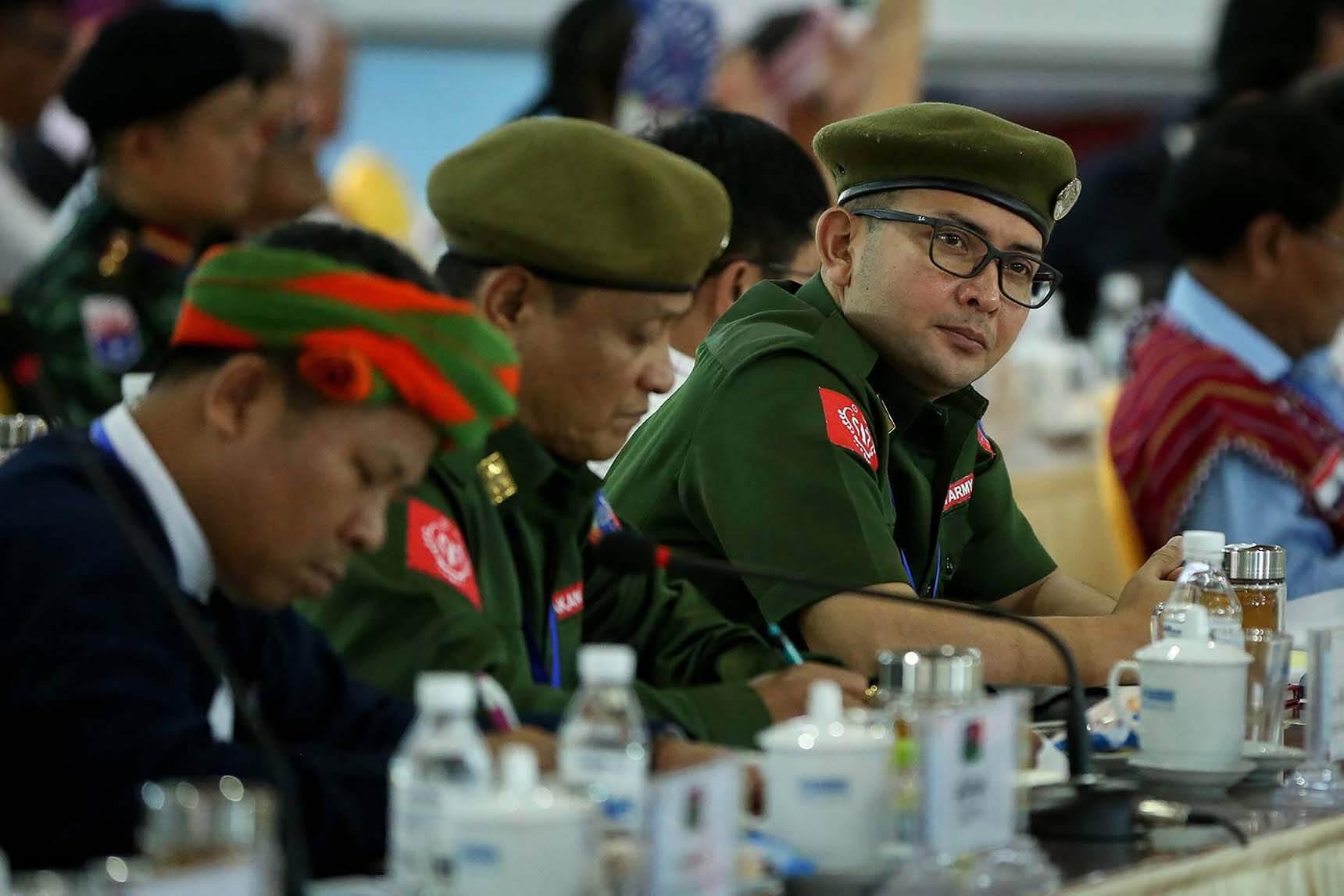
Leaders of the Arakan Army gather with other leaders and representatives of various Myanmar ethnic armed groups at the opening of a four-day conference in Mai Ja Yang in northern Kachin State on 26 July 2016. Photo by STR/AFP via Getty Images.
The AA’s battlefield achievements since the 2021 coup — including the siege of the western RMC in Ann township and the extension of its control across much of western Myanmar (see map below) — make it by far the most important and powerful armed actor in western Myanmar. However, significant challenges remain in consolidating these quick victories into a militarily defensible AA-controlled Rakhine state where local people can prosper under a competent ULA administration.

Balancing local challenges and regional ambitions
The AA has transformed from a nascent, border-based group into a multi-theater armed actor with national influence. While consolidating control over Rakhine and southern Chin states, the AA is increasingly shaping the trajectory of Myanmar’s broader conflict through new offensives in Ayeyarwady, Bago, and Magway regions. By leveraging cross-border access and threatening or seizing key military assets and foreign-backed infrastructure, the AA reshapes regional dynamics and demands international recognition — particularly from neighboring powers such as China and India. But this growing operational reach, control over critical infrastructure, and confrontations with a range of actors — including Rohingya armed groups — put the AA in a new phase of protracted and complex conflict.
AA advances threaten military industrial infrastructure
The near-total control of Rakhine state has allowed the AA to expand its influence into neighboring regions. The AA’s recent operations suggest it understands that, in the current context of military rule, stopping at liberating Rakhine state alone is insufficient for securing lasting control of it. To consolidate its gains and preempt future threats, the AA has opened new conflict frontiers east of the Rakhine mountain range, advancing toward military bases and strategic areas along key overland routes between Rakhine state and the central regions (see map below). The AA’s capture of southern townships in Rakhine state has especially enabled it to push into locations that have not often been under the influence of EAOs in Myanmar’s many decades of civil war. Using key logistical corridors — such as the Gwa-Ngathaingchaung road into the Ayeyarwady region, the Ann-Padan road into Magway, and the Toungup-Padaung road into Bago — the AA projects military and political reach beyond Rakhine state, all the while preempting junta counterattacks and disrupting supply lines.

The AA’s advance into Magway region, in particular, has brought the group close to core military production sites. Its operations along the Ann-Padan road threaten Weapons Factory No. 14, known for producing explosive primers. The AA’s positioning in Magway and Bago regions could allow it to encircle and threaten multiple weapons factories, including weapons manufacturing facilities, as well as the military’s only training school for arms production technicians. Simultaneously, the AA’s eastward incursions into Ayeyarwady region are forcing the Myanmar military to deploy troops to civilian areas where its strength and capacity have long been limited. The AA has quickly exploited this weakness to expand its operational footprint in Ayeyarwady, turning it into an active conflict zone. Before the 2021 coup, there were no more than five violent events per year in the region. In 2025, ACLED already records more than 300 events, with the Gwa-Ngathaingchaung corridor emerging as a central axis of AA activity.
The AA’s push into Ayeyarwady region also puts Pathein, the regional capital home to the southwestern RMC and a local airport, within striking distance. Beyond symbolic value, Pathein serves as a logistical hub for air operations against Rakhine state and other contested areas.
This expansion also enabled deeper alliances with post-coup resistance groups in Bago, Ayeyarwady, and Magway regions. The AA has reportedly provided full or partial military training, ammunition, and logistical support to at least 23 armed groups across 61 townships nationwide. Of these, 18 operate in Chin, Magway, Bago, and Ayeyarwady regions — an astounding projection of political and military influence by a comparatively new EAO.10 By fighting alongside these allied forces, the AA has been able to create buffer zones11 and attack vulnerable military bases and outposts in frontiers that were previously considered peripheral to the conflict in Rakhine state. In around 45% of its operations in these areas, the AA has fought alongside allies. In the Magway region, the most lethal front, only 32% of operations have involved allied forces — signaling the AA’s growing independent capacity.
AA’s rise reshapes regional dynamics
The AA’s control of strategic towns in Rakhine state provides it political and strategic leverage over the Myanmar military and regional actors such as China, India, and Bangladesh. The most consequential victory came with the capture of Ann township, which was home to the military’s western RMC. The fall of Ann crushed the military’s ability to project power in the state and brought critical infrastructure and foreign investments under AA control — most notably the China-Myanmar oil and gas pipeline station in Ann township, a vital component of the China-Myanmar Economic Corridor that aims to connect China's Yunnan Province to the Indian Ocean. By December 2024, the AA had gained full control of two and partial control of eight of the 11 major Chinese-backed projects in Rakhine state.12
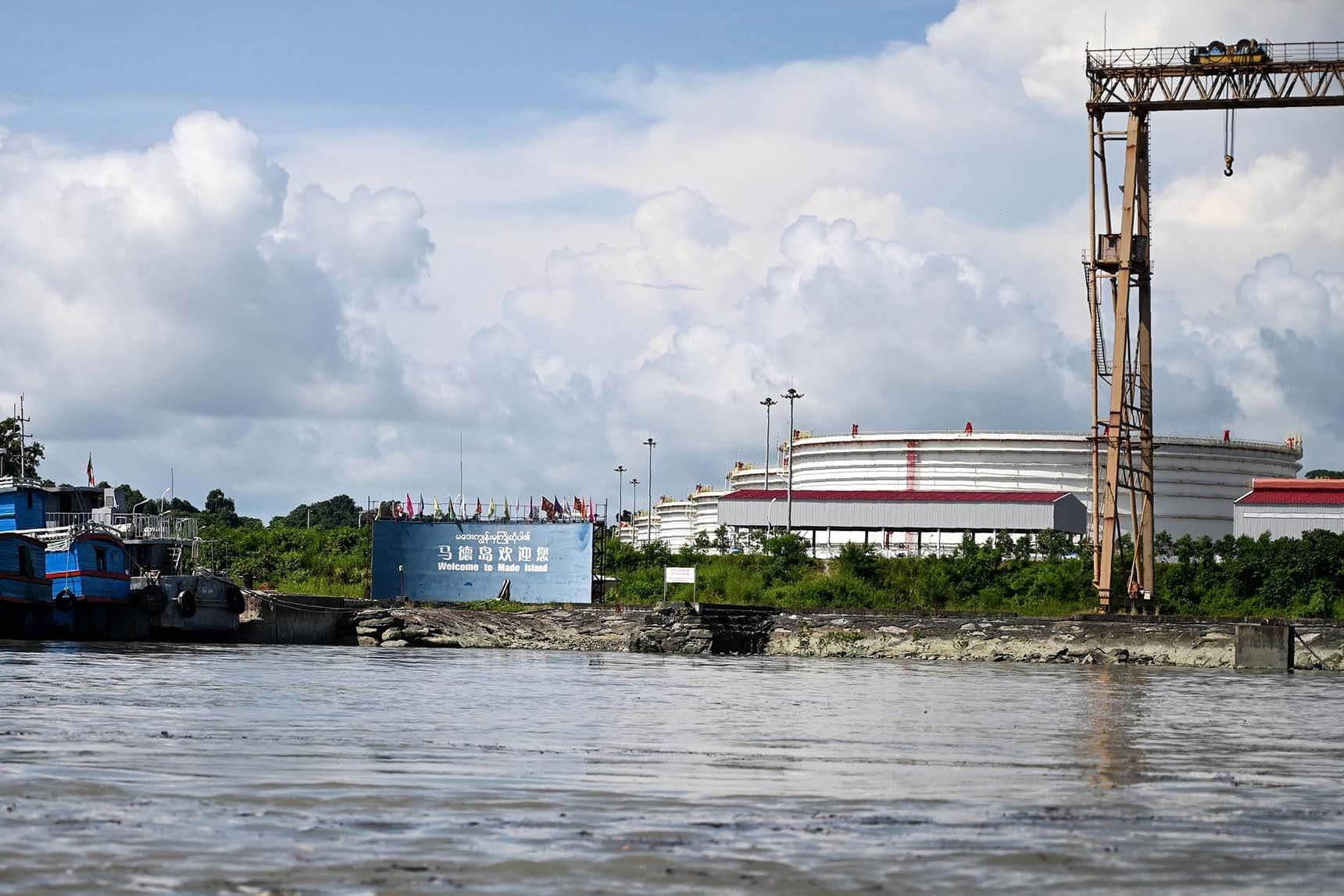
A Chinese-owned oil refinery plant, photographed from a boat on 2 October 2019, is located on Made Island off Kyaukphyu, Rakhine State. Photo by Ye Aung Thu/AFP via Getty Images.
India’s Kaladan Multi-Modal Transit Transport Project, a strategic infrastructure initiative implemented under India’s Act East Policy to counter China’s Belt and Road Initiative, also passes through townships under the AA’s control. The route includes a sea link to Sittwe Port, a river route through Paletwa, and a land corridor passing through Pauktaw, Ponnagyun, Mrauk-U, and Kyauktaw townships. The AA controls all of these except Sittwe.
Beijing and New Delhi increasingly look at the AA to ensure the stability and continuity of these infrastructural projects. Recognizing its strategic leverage, the AA has publicly positioned itself as a guarantor of development and security in the territories it controls, offering to safeguard foreign-funded projects. In doing so, it has begun framing itself as a responsible stakeholder in regional development.13
More complicated is the prospect of repatriation for the approximately 1 million stateless Rohingya refugees sheltering from conflict in Rakhine state in neighboring Bangladesh. While most of these fled Myanmar military violence in 2017 and before, an estimated 150,000 Rohingya have fled Rakhine state for Bangladesh since the AA took control of the western townships of Buthidaung and Maungdaw in the last year.14 With the AA now in firm control of all of western Rakhine state, including previously Rohingya-majority Maungdaw, plans for repatriation require Bangladeshi and international engagement with the AA.
The AA has sent mixed signals over the years and has been ambivalent at best about repatriating Rohingyas. However, if the AA ever prioritizes this process, it would gain significant political capital internationally, and potentially nullify the nascent Rohingya armed insurgency against the AA operating out of the Bangladesh camps.
Local threats to the “Arakan Dream”
With the AA’s growing power as a national and regional actor, it faces a range of new opponents — including Rohingya armed groups — signaling a new phase of protracted and complex conflict. In Maungdaw district, the security and humanitarian situations have deteriorated as fighting has resumed between the AA and Rohingya armed groups. The Myanmar military, which is responsible for the 2017 Rohingya genocide and mass displacement into Bangladesh, has co-opted Rohingya armed groups operating in refugee camps in Bangladesh to fight against the AA, in concert with some Bangladeshi authorities.15 These alliances reportedly involve the military offering incentives such as travel documents, compensation, and material support.
Violence has escalated amid accusations against the AA of committing serious human rights abuses, including killing hundreds of Rohingya civilians, conducting arbitrary arrests, and displacing hundreds of thousands.16 From November 2023 to September 2025, ACLED records more than 70 clashes between the AA and Rohingya armed groups, compared to just three between November 2021 and September 2023. These developments have not only deepened local instability but could also undermine the AA’s claim to legitimacy in the eyes of international actors.
In southern Chin state, the AA has formally incorporated Paletwa township, which is home to a significant non-ethnic Rakhine population, into its administrative structure, alongside maintaining a strong military presence in the area. The AA has asserted civil authority by establishing local administrative mechanisms such as checkpoints and border passes for people seeking to cross to and from India.17 It has also formed a tactical alliance with the Chin Brotherhood, a coalition of resistance forces operating in southern Chin state. The Chin Brotherhood has not publicly objected to the AA’s control over Paletwa, but other Chin political entities, especially those under the separate Chinland Council, have condemned it, accusing the AA of undermining the Chin people's right to self-determination.18
Even though the AA has not clashed with Chin resistance forces, civil society groups have accused the AA of forced recruitment, arbitrary detentions, movement restrictions, and undermining religious and educational freedoms in the state.19 These frictions highlight potential limitations of the AA’s expanding governance model, particularly in ethnically diverse areas. The AA is unlikely to cede or walk away from Paletwa, as border trade with India is crucial to its attempts to normalize life in the state under ULA rule in the long term.
What’s next for the AA?
In August, the AA reaffirmed its priority on consolidating its control of Rakhine state and capturing the remaining military-held areas in Kyaukphyu, Sittwe, and Manaung townships.20 Achieving these goals is complex but necessary for the AA to fully establish political legitimacy, economic sovereignty, and regional influence. If successful in these remaining townships, the AA could fundamentally alter the power dynamics in western Myanmar and shape the region's future trajectory.
The AA’s remaining targets in Rakhine state are, in operational terms, all military strongholds on peninsula and island territories that are defended through unrivaled navy and air force operations marshalled from outside the state (see map below). The AA has made notable gains in controlling inland waterways and disrupting some military supply lines, but like all other armed actors fighting the military, it cannot compete in the air. It would be more achievable, but still require considerable tactical ingenuity, for the AA to mitigate or disable the military’s naval advantages.

The AA’s increased pressure on Kyaukphyu has generated regional and international attention, particularly from China and India,21 which both maintain ties with Myanmar’s military and have investment stakes in Kyaukphyu and Sittwe, respectively (see map above). If the AA can take control of the area without further affecting foreign investment and infrastructure projects, it would be positioned to be a major beneficiary of regional economic corridors to Myanmar’s two largest neighboring countries. This, in turn, would entrench its political relevance over the longer term.
On the other hand, reckless full-scale assaults on Kyaukphyu and Sittwe would not only draw the ire of India and China, both of which currently support the military regime, but would likely result in huge civilian casualties, as tens of thousands of displaced Rohingya people are confined against their will in military-controlled camps in the city.22 This would provide further evidence that the AA does not value Rohingya lives. The AA is unlikely to gain control of these towns before the military’s elections, which are planned to begin in December 2025. The military is currently stepping up counteroffensives to recapture Thandwe, Gwa, Ann, and Toungup townships, where it plans to hold the polls. If the AA somehow succeeds in eventually taking the remaining military holdouts in Rakhine state, it will not only cement its military dominance over the entire state, but also significantly enhance its leverage in any future political dialogue — positioning itself as a central force in reshaping a future Myanmar.
With other major EAOs, such as the MNDAA and TNLA, facing setbacks in northern Myanmar, the AA’s advances east out of Rakhine state could boost revolutionary morale nationwide. By extending its operational reach into the Ayeyarwady region, the AA is not only disrupting military logistics but also shifting the balance of power in areas closer to the military regime’s political heartland. The AA is in place to play a leadership role among resistance groups in Magway, Sagaing, and Bago regions, where around 800 currently active resistance groups continue fighting the military. By coordinating more closely with armed groups there, the AA could bolster their organizational infrastructure, improve combat capacity, and potentially incorporate some allied forces into larger, more structured command systems, enabling more coherent strategic operations.
This could bring increased organization and strength to an area of critical military significance that contains both weapons factories and air bases and that has direct lines of access to Yangon, the former capital and the country’s largest city, and Naypyitaw, the military capital. Any disruption to military infrastructure or logistics routes in this zone would affect the military’s domestic weapons manufacturing capacity, hampering its ability to sustain long-term operations without transforming its logistics. This would be a boon for the AA and its allies, particularly as the AA’s stockpile of captured military ammunition could run out as early as next year.23 Attacking the source of the military’s arsenal — rather than relying solely on captured arms — could shift the balance further in favor of nationwide resistance.
To the west, the AA's territorial consolidation along the border with Bangladesh presents both strategic benefits and complex geopolitical and ethnic challenges. While the AA has become the de facto authority in Rakhine state, informal dialogue with various Bangladeshi and Indian authorities has so far failed to result in the formalization of relationships with their national governments. So, while the AA’s capture of Maungdaw and other border towns has opened obvious opportunities for cross-border trade and humanitarian aid, the AA cannot yet fully capitalize on them. Rohingya armed groups operating against the AA from Bangladesh24 and Chin agitation against AA rule in Paletwa25 also complicate more concrete steps toward normalizing relationships with local Bangladesh and India border actors.
Finally, while more AA military successes in Rakhine state and the western regions would certainly improve the morale and momentum of the national movement against military rule, civil war would still continue. The Myanmar military regime is well supported by China and other nations, and its many opponents remain diffuse and divided, with different priorities, political visions, and pressure points. The AA’s long-term political vision of the Arakan Dream is itself centered on establishing an autonomous, unitary “Arakanese” state, rather than on joining a broader federal democratic union, which is the political principle with the most support in the anti-military resistance movement. As long as the AA maintains this vision, deeper integration with federalist opposition forces, even with increased battlefield coordination, will be constrained.
Footnotes
- 1
- 2
- 3
- 4
- 5
Kyaw Hsan Hlaing, “Understanding the Arakan Army,” Stimson Center, 21 April 2023
- 6
Aung Tun, “The Arakan Dream in Post-Coup Myanmar,” ISEAS Yusof Ishak Institute, 14 July 2022
- 7
- 8
Kyaw Hsan Hlaing, “Understanding the Arakan Army,” Stimson Center, 21 April 2023
- 9
- 10
ISP Myanmar, “The AA’s Post-Coup Network of Alliance,” 18 July 2025
- 11
- 12
ISP Myanmar, “10 Chinese Projects in Rakhine State Under AA’s Control,” 24 December 2024
- 13
Development Media Group, “AA welcomes foreign investment in Arakan State,” 29 December 2024; Maung Kavi, “Myanmar Junta Pushes Key Chinese Projects in Rakhine Despite Looming AA Threat,” The Irrawaddy, 16 January 2025
- 14
- 15
International Crisis Group, “The Dangers of a Rohingya Insurgency,” 19 June 2025
- 16
- 17
- 18
- 19
BBC Burmese, “Chinland Council says AA commits human rights violations in Chin state,” 12 June 202 (Burmese); CNI News, “Chinland Council says AA establishes administration by force and bans freedom, 14 June 2024; Facebook, “Chin groups reject the AA’s administration of Paletwa as a Rakhine district,” 13 August 2025 (Burmese)
- 20
Development Media Group, “AA reassures its pledge to seize entire Arakan State,” 13 August 2025
- 21
Anthony Davis, “Arakan Army holds the key to breaking Myanmar’s junta,” Asia Times, 26 March 2025; Lorcan Lovett, “China, India watch as Arakan Army advances on key western frontier,” Al Jazeera, 23 August 2025
- 22
- 23
- 24
International Crisis Group, “The Dangers of a Rohingya Insurgency,” 19 June 2025
- 25